
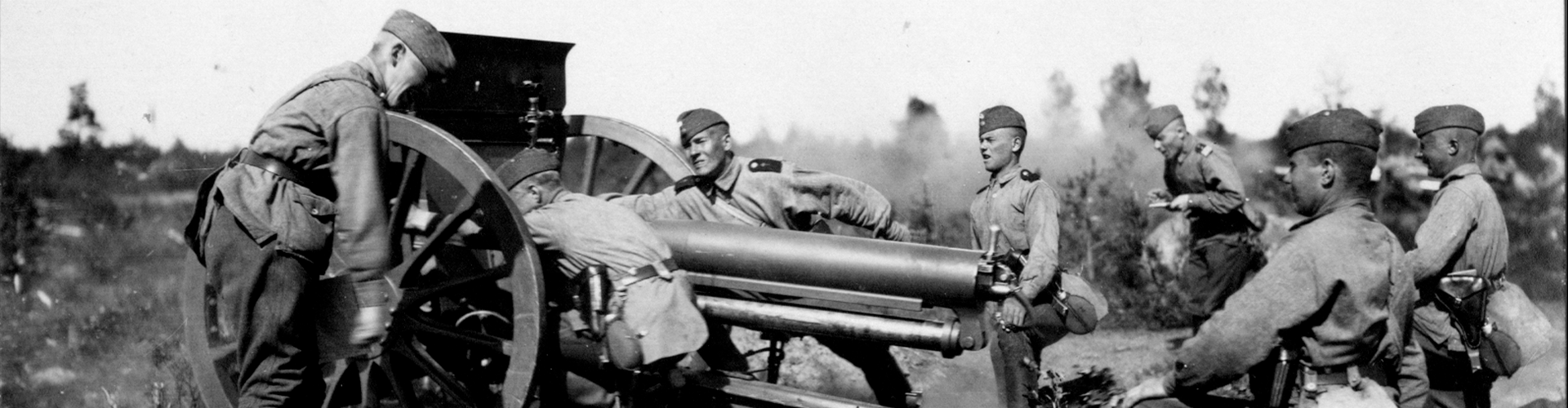
Training of the regular staff
The Finnish School of Artillery, established during the Civil War, was abolished in October 1918. The training of artillery officers was supplemented by refresher courses in Helsinki from autumn 1919. In 1920, the Artillery School of Firing (finnish: Tykistön Ampumakoulu) was established to provide further training. The school was not a permanent organisation, but was started whenever a suitable number of officers were enrolled. Teaching was very theoretical, especially in the early years. The artillery line was added to the Military Academy in 1927. The first regular field artillery NCO were either jaegers or had completed the NCO course at the Finnish Artillery School. In early 1921, the Field Artillery Capitulant Officer School (finnish: Kenttätykistön Kapitulanttiupseerikoulu) was established for the training of regular NCOs. In 1928, the training of regular non-commissioned officers was centralised at the Battle School (finnish: Taistelukoulu) in Viipuri.
Conscript training and refreshal training
Field artillery training in Finland was initially divided into different trends, depending on the backgrounds of the instructors. During and immediately after the Civil War, the Swedish influence was strong. Finnish artillery officers trained in Russia brought in their own influences. With the arrival of the Jaeger, however, the German influence remained the strongest. The first Finnish written instructions for artillery were handouts based on lectures given at different courses, which were the basis for the first artillery instructions, the 'Field Artillery Firing Instructions', in 1924.
Conscript training usually consisted of lessons in the mornings and outdoor service in the afternoons with gunnery exercises. Because of the large number of horses needed by the artillery, stable duty was an important part of the gunner's life. In the early days, the problem was that conscripts' time was taken up with various garrison duties, due to their poor condition, instead of training in the artillery.
Conscripts selected as non-commissioned officers were trained at regimental reserve non-commissioned officer schools. The first reserve officers graduated from the officer training courses at the Finnish Artillery School. The Hamina Reserve Officer School initially provided uniform training for all students. In 1922, a limited artillery section was added. The actual training in the various branches of the armed forces was to be given only period in the units. The system was not working, and in the autumn of 1924 an artillery section with its equipment started at the Reserve Officers' School. The actual line division in the Reserve Officer School came into force in 1927.
As in other branches of the armed forces, artillery refresher training began in 1925 with the training of reserve officers only. Only after the transition to the areal system were refresher training exercises for the entire artillery forces of the wartime formations organised.