
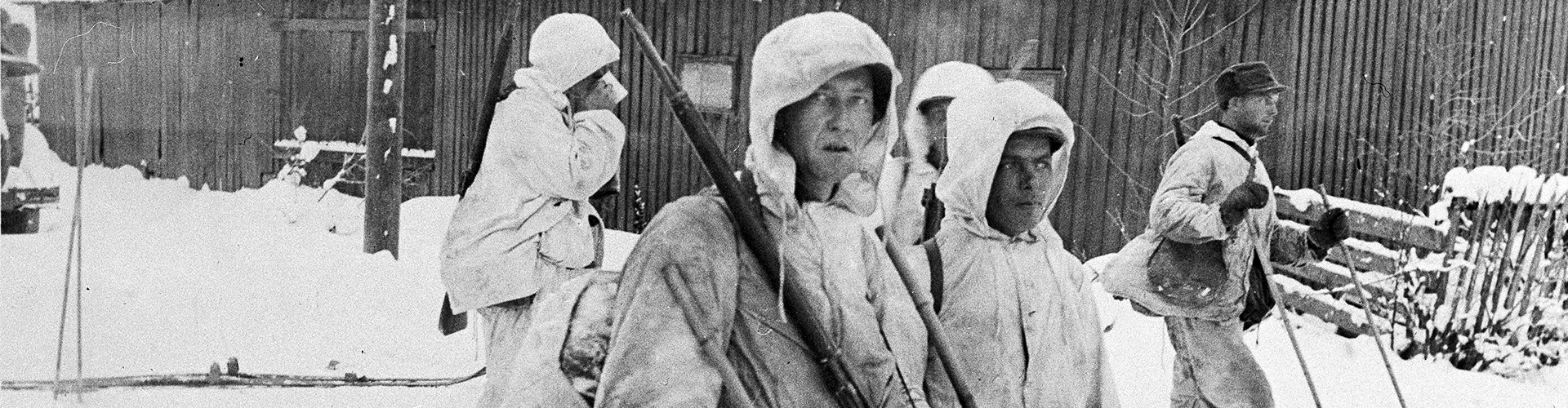
Talvisota
War starts
In the early morning of 30th of November, the Red Army's artillery opened fire and the infantry crossed the border in Karelian Isthmus, north of Lake Ladoga and in Petsamo. According to the official Soviet announcement, the attack was a direct result of the "shots fired by the Finns" to village of Mainila. Later, after the opening of Russian archives, researchers have confirmed the Finnish view at the time: the shelling was a reason invented by the Soviet Union to start the war.
At 9.15 a.m. Red Army bombers appeared over Helsinki. Nothing more happened, however, and many assumed that the planes were the Soviet Union's way of threatening Finland into agreeing to cede territory. In the afternoon the planes returned and this time the bombing began. Finnish President Kyösti Kallio declared a state of war and handed over the post of Commander-in-Chief of the Defence Forces to Marshal Carl Gustaf Emil Mannerheim.
Before the war, it had been assumed that the main theatre of potential war would be on the Karelian Isthmus, but now the enemy attacked along the entire border. On the Isthmus, the fierce attacks of the Red Army were repelled until mid-February. North of the Ladoga, the few defenders stopped, repulsed or destroyed the attacking divisions in large-scale encirclement battles called "Motti" battles.
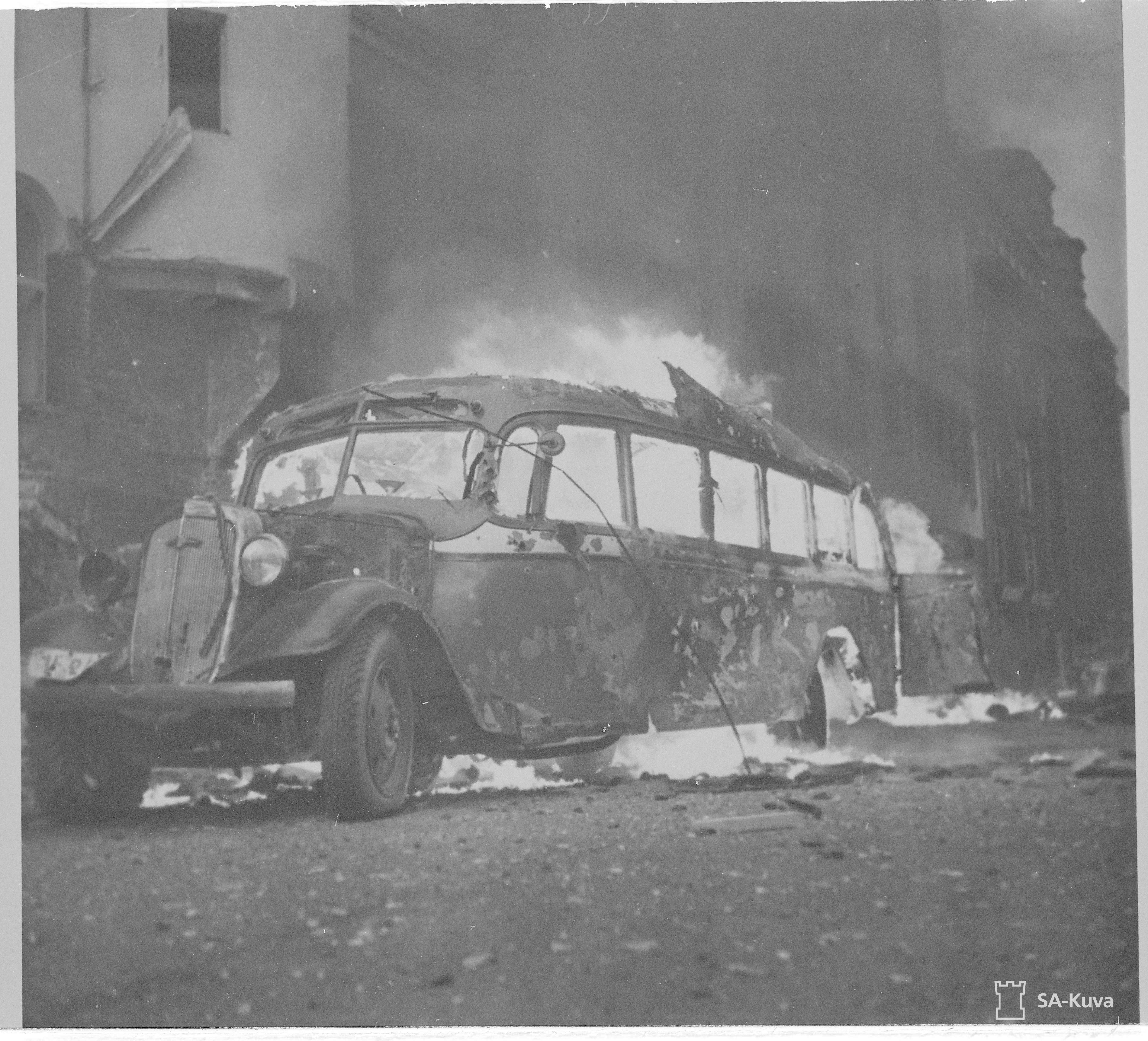
A bus caught in flames after bombing in Helsinki 30th of November 1939.
Soviet puppet-government or "Terijoki Government"
The Soviet way of speaking involved turning words and concepts on their head. Thus, in its own words, the Soviet Union, far from attacking Finland, came as a benevolent and invited helper.
The request for help to Stalin had been sent "from somewhere in Finland" by a government led by Otto Wille Kuusinen. Kuusinen's government was a pure puppet government invented by Stalin. Otto Wille Kuusinen was a Finn who had risen to the highest echelons of the Soviet hierarchy. The other members of the government were relatively unknown.
Stalin had assumed that Finland's defences would collapse in two weeks. The Soviet Union's main objective at the start of the Winter War was to take over the whole of Finland and establish a puppet government loyal to Moscow. The defensive struggle of the Finnish army and the growing interest in the Winter War, especially on the part of the Western powers, and the possibility of an escalation of the war, forced Stalin to reassess. The Soviet Union might find itself at war with the Western powers if it attempted to take over the whole of Finland. He decided to call off the Winter War.
By the end of January, Kuusinen's time was up and a negotiating contact to end the war was made with the Finnish government.
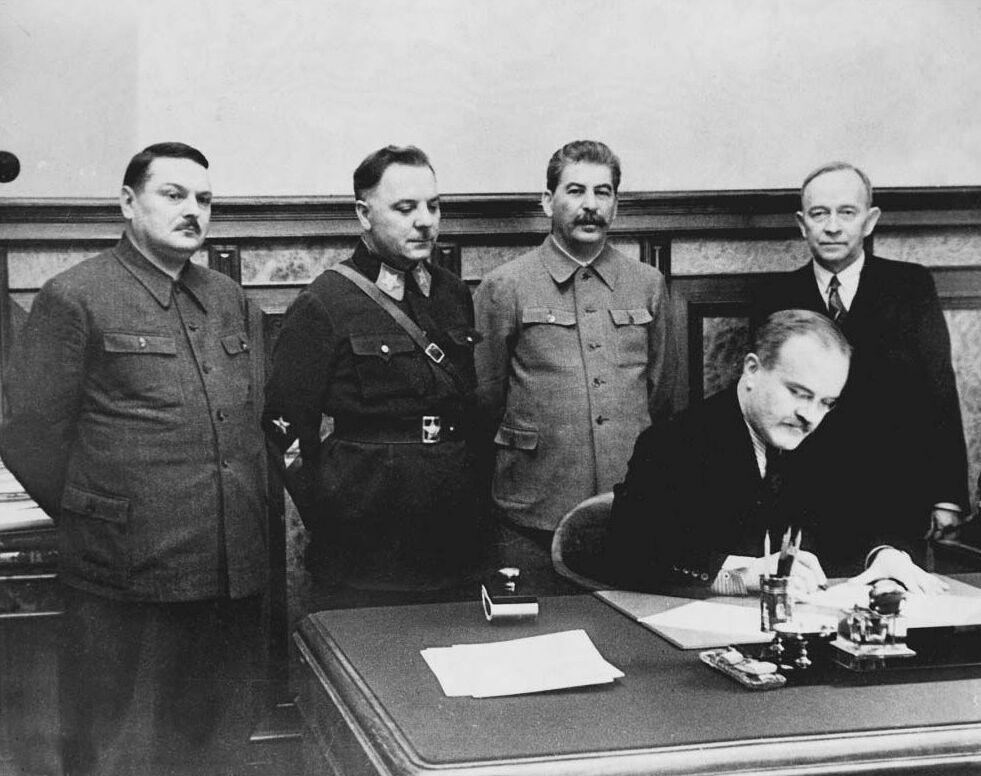
Otto Wille Kuusinen pictured on the right.
Peace
The tenacious fighting of the Finnish army took the Soviet leadership by surprise. Soviets had anticipated a quick war. The Red Army had suffered a serious loss of prestige when it was forced to wage a real war against Finland instead of a parade march. A small military expedition, the 'conflict', which had seemed harmless to the great power, threatened to lead the Soviet Union into a major war against the Western powers. The writer Hella Vuolijoki had, on her own initiative, contacted the Finnish Foreign Minister Väinö Tanner and asked permission to go and explore the possibilities of peace with her old friend Alexandra Kollontai, the Soviet ambassador in Stockholm.
Tanner, surprised by the new situation, gave Vuolijoki the task of conducting peace talks in Stockholm on 8th of January 1940. The outcome of the peace talks was Molotov's reply of 29th of January 1940, according to which the Soviet Union had no obstacle in principle to concluding an agreement with the Ryti-Tanner government.
Peace was signed 12th of March 1940 and hostilities ended the next day. Finland was forced to cede territories to Soviet Union. The harsh peace terms shocked the Finns. The peace treaty forced Finland to give up several areas which the enemy had been unable to take in battle. The Finns were persuaded to accept peace by stressing that it guaranteed Finland's independence as a safer alternative to the uncertain defensive struggle.
Peace was also disadvantageous for the Soviet Union. Its losses in the Winter War were heavy compared to the advantages gained. Moreover, the tenacious resistance of a small nation had dented the Soviet Union's prestige as a great power. As a result of the Winter War, Finns were left with a strong suspicion of their neighbour's ambitions and fear of a new invasion. The Soviet Union also had reason to suspect that Finland was seeking reparations and new military allies.