
The Trench Warfare
Territories lost in the Winter War were officially reattached to Finland by a unanimous decision of the Parliament on Finland’s Independence Day, December 6, 1941. A significant part of the displaced population forced to leave their homes during the Winter War returned to their home regions during the period of positional warfare. As the war dragged on, it became clear that East Karelia would not become a permanent part of Finland. However, the occupied areas were considered as a kind of pawn for future peace negotiations.
About 85,000 civilians remained in the areas of East Karelia occupied by Finland. The Finnic population was privileged until autumn 1943, and different population groups were resettled separately. Finnish assimilation policies were especially directed at children. Russians were also confined to transfer camps, where their number reached over 20,000 at maximum. Due to insufficient food supplies, about 2,500 of them died. Nearly 19,000 Russian prisoners of war also died in poor conditions in prison camps.
The phase of positional warfare on the Finnish front lasted from December 1941 until summer 1944. The front lines remained nearly unchanged. North of Karhumäki, the front was discontinuous over large wilderness areas and based on field patrols. Soviet partisans managed to operate within Finland and also attacked civilian targets, killing 181 Finnish civilians during the war, including women and children.
Life at the Front
The largest battles of the positional warfare phase took place on the Maaselkä Isthmus, Kiestinki, and Syväri during the winter and spring of 1942, when the Red Army attempted strong attacks to break the Finnish defense. The attacks were repelled in difficult conditions, and the fronts stabilized again. Positional warfare mainly consisted of local skirmishes, reconnaissance, and guard duty. Artillery barrages, snipers, and prisoner capture patrols were constant threats to frontline soldiers. Finnish long-range patrols operated far behind Soviet lines.
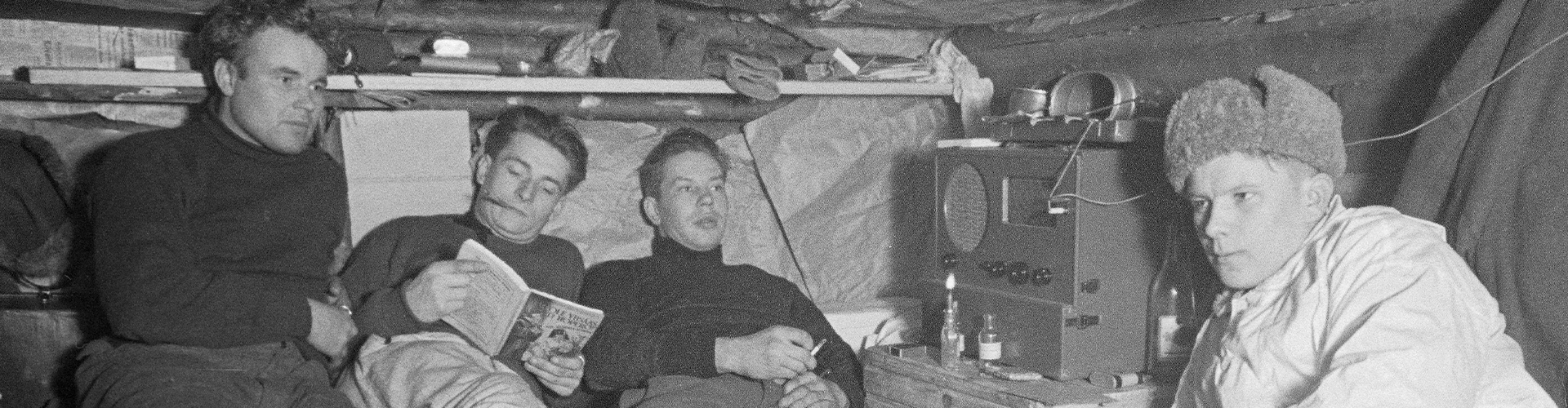
Older age groups were released from military service to home front work, and soldiers’ rotation leaves began. Defensive positions were fortified, roads repaired, and living conditions improved at the front. Cleaning duties were an important part of soldiers’ free time. Entertainment tours, front-line radios, and newspapers were used to lift morale lowered by inactivity and frustration. Soldiers’ homes and canteens were opened, and communication with home was maintained via field post. Sports competitions also helped maintain combat readiness. In addition to military training, young men at the front had opportunities to complete unfinished studies.
Effects of the World War Situation on Finland
The German advance halted at the outskirts of Moscow at the end of 1941. In the summer of 1942, the Germans advanced further on the southern front. However, in autumn, the situation began to turn. The Battle of Stalingrad, which ended in Germany’s defeat in early 1943, marked a turning point. The Allies took control of North Africa and launched an invasion of Sicily in the summer of 1943. Italy surrendered in autumn 1943. Heavy air raids on German cities brought the war to German soil. The siege of Leningrad was broken in January 1944. By the end of 1942, the highest leadership in Finland began to realize that the war would not end in a German victory. At a meeting in Mikkeli in February 1943, it was concluded that Finland should aim to withdraw from the war. However, German troops were still in northern Finland, and Finland’s supply was largely dependent on Germany, complicating efforts for a separate peace. From spring 1943 onwards, Finland occasionally communicated with Moscow to clarify peace terms, but the conditions were considered unacceptable.