War clouds over Europe
The clouds of war began to gather in the skies of Europe in 1938, when Hitler annexed Austria to Germany. In September of that year, Germany demanded that Czechoslovakia cede its German-speaking Sudeten territories and got its way as the Western powers sought to appease Germany to avoid war. The following year, on 15th of March 1939, Germany invaded Czechoslovakia, shattering the credulous confidence of the Western powers in Hitler's peaceful appeasement.
The October Revolution in St Petersburg on 7th of November 1917, led by Vladimir Lenin and Lev Trotsky, seized power in Russia from the provisional government that had taken over from the Emperor earlier that year in the February Revolution. Lenin's government succeeded in consolidating power and in 1922 the Soviet Union was formed from Soviet Russia and the Soviet republics that had seceded from Russia in the wake of the revolution. In the power struggle that followed Lenin's death, Joseph Stalin rose in power. Stalin concentrated power in his own hands and defeated his opponents through bloody purges.
Stalin and Hitler were dictators who pursued their ends by any means necessary. Under Stalin's leadership, what had once been an agricultural country was painstakingly transformed into an industrial state by means of five-year plans.
However, Soviet citizens were hardly able to enjoy the prosperity of industry, as the main focus of production was on heavy industry. According to Stalin, the Soviet Union was surrounded by hostile capitalist states and had to prepare for war. Hitler's Germany made no secret of its hostility to the Bolsheviks.
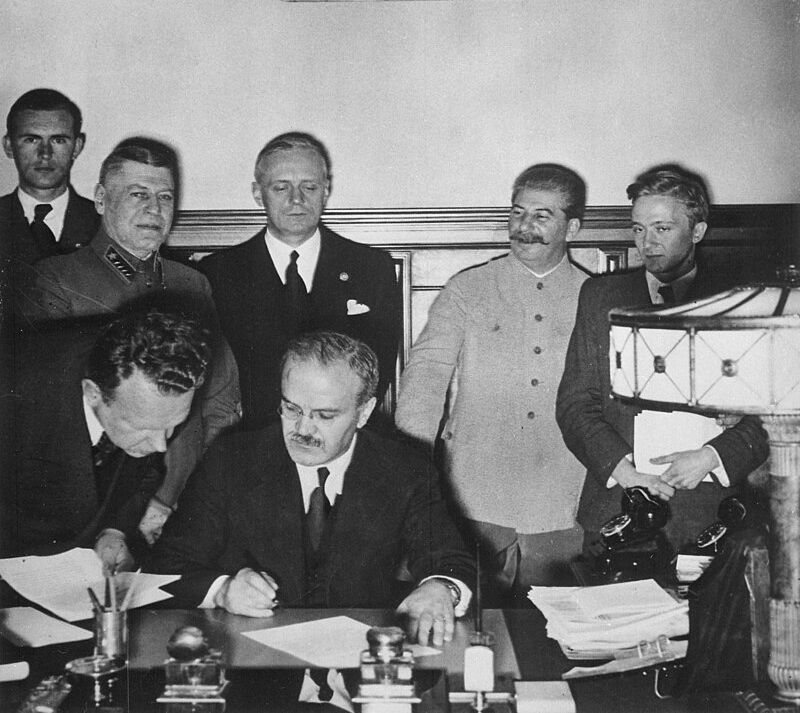
Molotov-Ribbentrop Pact
Britain and France sought support from the Soviet Union to keep Germany in check after the invasion of Czechoslovakia in 1939 and sent a negotiating mission to Moscow, but the talks stalled without reaching a conclusion. The Soviet Union would have liked to give its neighbours a 'guarantee' against an indirect attack, even if they did not ask for or want a 'guarantee'. This guarantee would have meant, in practice, moving Soviet troops into the territories of neighbouring countries, if the Soviet Union so wished.
The Western negotiators left Moscow empty-handed, but the new treaty partner was already trying to curry favour with Stalin. Ideological enemies Hitler and Stalin unexpectedly found a common ground for negotiations. Ideology and mutual propaganda were quietly forgotten. The Soviet Union and Germany unexpectedly concluded a non-aggression pact on 23rd of August 1939. A secret additional protocol agreed on the division of the spheres of influence in eastern parts of Europe. According to this secret agreement, inside Soviet sphere were Finland, the Baltic States and the eastern parts of Poland.
The agreement was mutually advantageous. Germany would avoid the two-front war that proved fatal for it in the First World War, while the Soviet Union could accelerate its military-industrial production and expand its army in peace. At the same time, Stalin could watch in peace as the Western powers and Germany starved each other in the war that was about to begin.
In Finland, the Soviet-German non-aggression pact was greeted with relief - the threat of war was thought to be gone. When the treaty was announced, there was no mention of a secret additional protocol, and even after the Second World War the Soviet Union denied the existence of the secret treaty.