
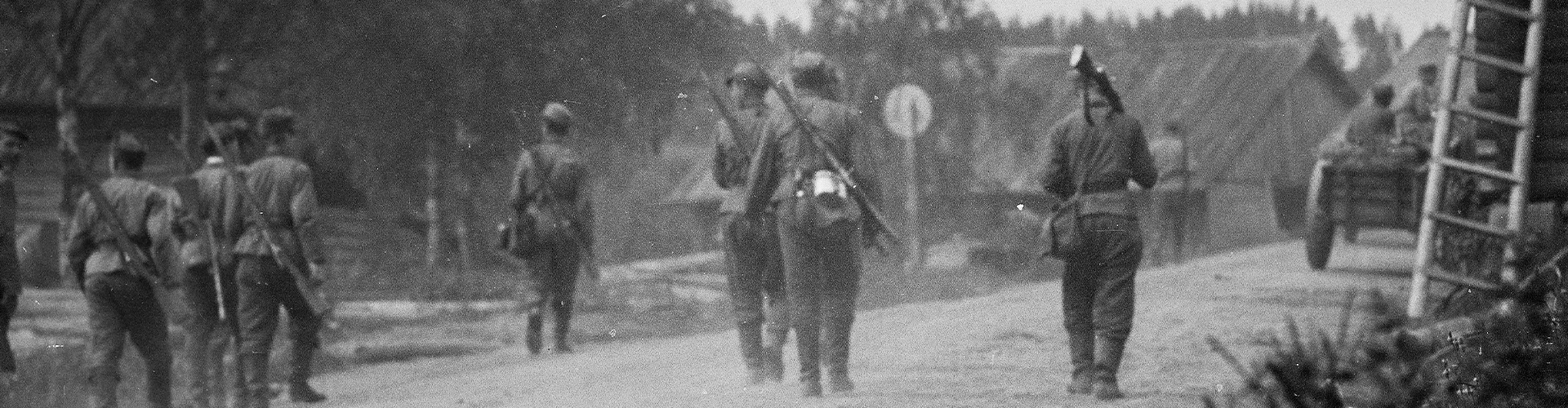
Major Soviet Offensive in summer 1944
Defensive Positions on the Karelian Isthmus
The main defensive line was largely located in open and flat terrain, poorly suited for defense, and difficult to fortify due to continuous combat contact. Part of the position consisted of only a single continuous trench. There were no anti-tank obstacles, and minefields were scarce. The defense lacked depth, and the reserves needed for counterattacks were insufficient.
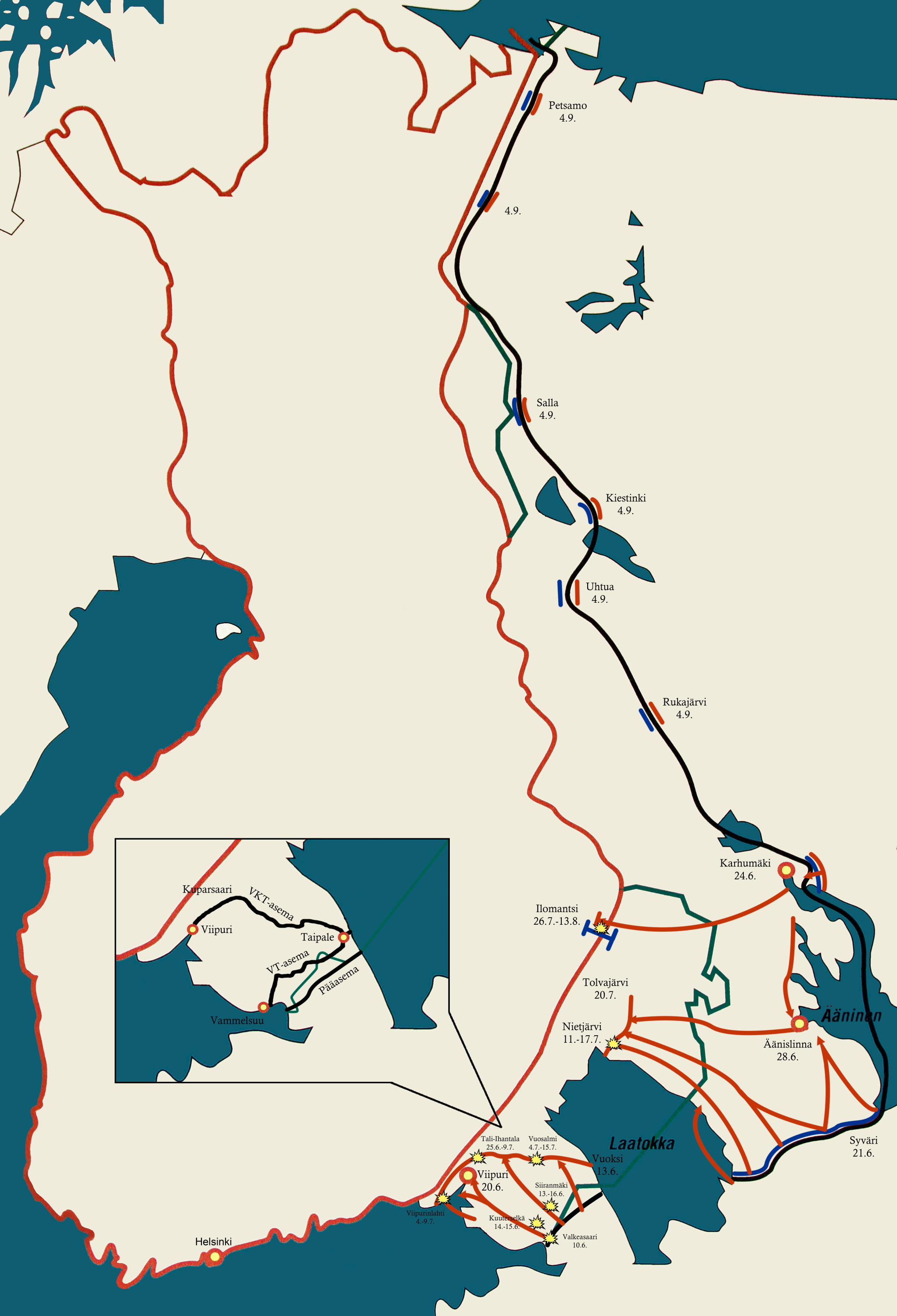
The VT-line, running from Vammelsuu to Taipale, was geographically more advantageous than the main line. This position had been fortified since 1942, but by the summer of 1944, it was still unfinished due to a shortage of labor and materials.
The last defensive position on the Karelian Isthmus ran from Viipuri through Kuparsaari to Taipale. The waterways of this VKT-line, as well as its covered and partly rocky terrain, favored the defense. However, the VKT-line was unfortified.
Battles on the Karelian Isthmus
On June 9, 1944, at 6 AM, hundreds of Russian bomber and ground attack aircraft attacked Finnish troops. An hour later, the Red Army's artillery began firing with thousands of cannons, as well as mortars and rocket launchers. In the afternoon, infantry supported by tanks attacked. No significant breakthrough was made yet. However, the bombings and indirect fire had crushed the Finnish positions.
The breakthrough in Valkeasaari occurred on June 10. At 5 AM, an even fiercer artillery preparation began than the previous day. Approximately 220,000 shells were fired in two hours at the 10-kilometer wide sector of the Finnish 10th Division, and about 60,000 shells at the adjacent 2nd Division's sector. Men and weapons were buried in the sand and disappeared without a trace in the shelling. The Finnish withdrawal, delaying the enemy, began towards the VT-line. Fierce battles were fought on the VT-line at Kuuterselkä and Siiranmäki, but the defense did not hold, and delaying actions continued. Viipuri was lost on June 20.
After President Ryti's personal commitment that Finland would not withdraw from the war alongside Germany, more anti-tank equipment and the Kuhlmey air detachment were sent to Finland, leveling the balance of power in terms of air superiority. Resistance on the Isthmus strengthened, and in late June and July, fierce defensive battles at Ihantala, Viipuri Bay, and Vuosalmi halted the Red Army's advance. In the battles of Ihantala and Vuosalmi, the concentrated use of artillery fire was of great importance.
Battles North of Lake Ladoga
Troops were transferred from north of Lake Ladoga to the Karelian Isthmus to repel the Soviet grand offensive. The Soviet grand offensive in Aunus began on June 21. The positions east of Syväri were evacuated almost secretly, with engineers arranging the crossing.
The Finnish withdrawal, fighting delaying actions, was successful, even though the Red Army made a successful landing on the Ladoga coast. The troops of the Aunus Group took up defensive positions in a line named the U-line. The Red Army managed to make a breakthrough at Nietjärvi in mid-July but was eventually driven back.
A withdrawal also occurred from the Maaselkä Isthmus. After a heavy delaying phase, at Ilomantsi, Group Raappana, led by Major General Erkki Raappana, separated and encircled two Red Army divisions and defeated them in "motti" battles. The Battle of Ilomantsi, which ended in mid-August, was the last major offensive against Finland. The Red Army also regrouped into defensive positions.
Significance of the Defensive Battles
The defensive victories of summer 1944 at Viipuri Bay, Tali-Ihantala, Vuosalmi, Nietjärvi, and Ilomantsi formed a whole that stopped the Red Army's advance deeper into Finland.
The largest battle in terms of size was fought at Tali-Ihantala, but in terms of the overall picture, all battles were equally important. At Viipuri Bay and Vuosalmi, the Red Army's access to the Finnish flank and rear was prevented. If even one of the fronts had broken, the entire VKT-line might have been lost. As the attacks were persistently repelled, the Red Army regrouped into defensive positions on the Isthmus, and troops began to be transferred from the Finnish front south towards the battles advancing on Berlin.