
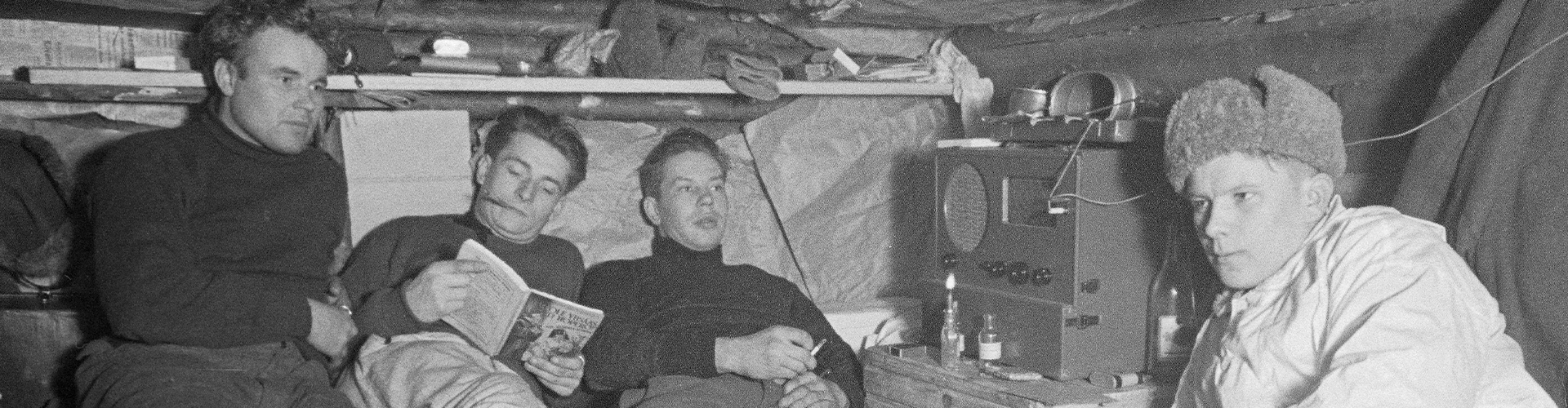
Engineers during the Trench Warfare
Strengthening the Defense and Clearance Operations
During the trench warfare phase, the tasks of the engineers were related to strengthening the defense. Many engineer battalions were also temporarily responsible for front-line duties similar to infantry. Engineers also participated in prisoner-snatching missions and reconnaissance and sabotage patrols behind enemy lines.
The duties of the engineers included participating in the field fortification of defensive positions. Division engineer commanders led the fortification of frontline troops. Rear positions were built by fortification construction units. Construction materials were mainly obtained through the engineers' field industry. Engineer battalions' field sawmills produced nearly 31,000 kilometers worth of sawn timber. The field industry also produced roofing shingles, bricks, firewood for wood-gas-powered vehicles, and tar.
The minelaying of defensive positions was an extensive operation carried out by the engineer squads of infantry regiments and engineer battalions, aiming to create a continuous infantry mine and alarm field in the front line. In 1944, the focus of minelaying shifted to constructing anti-tank minefields. During winter, engineer units built large-scale ice minefields, for example, on the Gulf of Finland, Lake Ladoga, and Lake Lempäälä. Mines used included Finnish anti-tank mines, German anti-tank mines, fragmentation-effect infantry mines such as the German "bouncing bomb" (jumping mine), domestic pipe mines, and pressure-activated mines like box and canister mines. Special ice mines were used for minelaying on frozen bodies of water.
The functionality of constructed minefields also had to be maintained by replenishing destroyed sections with new mines. The dismantling of minefields left in the rear and obstructing own operations was also among the duties of the engineers. Preparations for demolition in the rear began as early as summer 1943. During trench warfare, engineer units laid nearly 800,000 infantry and anti-tank mines, as well as nearly 350,000 ice mines. From cleared minefields, approximately 510,000 various mines were removed, along with over 27 tons of explosives from different sites.
Roads, Bridges, and Other Construction Work
Repairing and constructing roads and building field bridges employed engineer units extensively. Especially during seasons of poor road conditions, the maintenance of long supply roads and snow plowing in winter required great effort. During the trench warfare phase, engineer troops built and repaired nearly 9,000 kilometers of various roads. Over 1,000 field bridges were constructed with a total length of 21 kilometers. For example, three field bridges and a barge bridge were built across the Syväri River.
From 1942 to 1944, the 5th Army Corps’ engineer and fortification construction units built a 71-kilometer narrow-gauge field railway between the Murmansk railway and the shore of Lake Onega, operated with steam locomotives and wagons assembled from captured equipment. Shorter field railways were also built. Some railways were operated using wagons pulled by tractors. During trench warfare, Engineer Battalion 15 built the Ämmänsaari power plant for the needs of the army corps and the Suomussalmi parish village. Another exceptional construction project was carried out by an engineer detachment that built a new church to replace the destroyed Kivennapa church. Engineer units erected a significant number of accommodation and storage barracks and participated in the construction of war veteran homes for returning evacuees. In 1942–1943, field army units completed over 800 log frames for war veteran homes and erected 262 residential houses across the Karelian Isthmus.
Training Activities
During the trench warfare period, training activities took place both on the home front and in operational areas. Various manuals and guides supporting engineer training were produced between 1941 and 1944. The Engineer Training Center operated in Koria and Utti starting in September 1941. At its peak, about 2,000 trainees were present. Training from recruit to front-ready soldier took three months. In addition to general engineer training, some received training as assault boat operators, mechanics, flamethrower operators, and installers. Over 1,300 engineer squad leaders were trained through squad leader courses. The engineer non-commissioned officer school trained 176 permanent engineer NCOs during 1943–1944. Reserve officer training for engineers took place in Koria, where over 500 reserve officers graduated. During the war, the Army School of War graduated 52 engineer officers.
Further training courses for engineering personnel were held in Koria, Helsinki, Turku, Karhumäki, and Sammatti. Engineer officers were also sent on study tours and familiarization visits to Germany and its occupied territories. In 1942, 26 engineer officers completed a combat engineer course in Germany. In 1943, six engineer officers studied the activities of engineer units on the Leningrad and Moscow fronts, and four of them participated in a technical course for engineer battalion commanders in Germany. Two engineer officers attended a captain’s course at a German training center in France. One engineer officer completed an armored forces engineer battalion commander course in Paris, and another did so in Antwerp.