
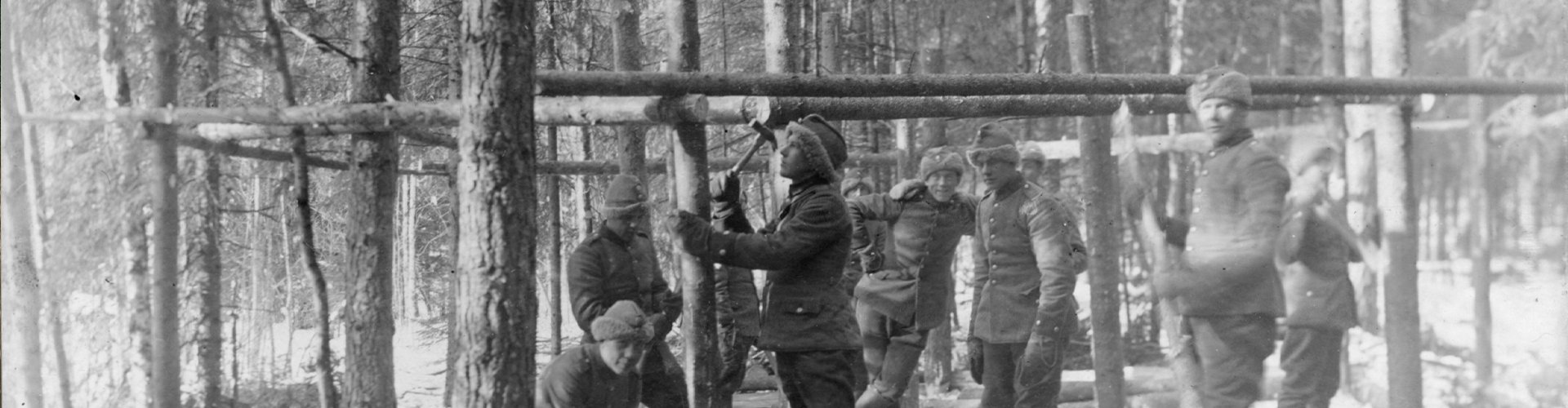
Training of the staff
From 1921 to 1927, non-commissioned officers of the engineer branch were trained at the Viipuri Infantry Capitulant School, whose curriculum included "field fortification and explosives training". When the school became the regular non-commissioned officer section of the Combat School in 1927, the curriculum included 'engineer service'. Tactical and engineer-technical exercises were held for regular NCOs in the engineer corps sections. They also gave training lessons to develop their skills in training conscripts.
Between 1919 and 1928, a two-year course of training was given to army cadets in accordance with a common curriculum, which included not only engineer studies but also mathematics and science. From 1929 to 1936, the curriculum was divided by branches. The cadets were trained in the first year in the school's technical department and in the second year in the department's engineering and communications line. With the return in 1937 to the common training programme for army cadets, the 1939 graduates of the Engineer cadets received their Engineer training at the Engineer units.
Between 1927 and 1939, the further training of officers of the Engineer and Signal Corps took place in two-year courses at the Military Technical School. In Viipuri, in the 1930s, on the initiative of the inspector of technical troops, Colonel Unio Sarlin, three-month lieutenant courses at the Combat School gave student officers of all arms training in fortification, road construction, demolition and water-crossing.
In 1923, the Mathematics, Science and Military Science Department of the civilian Technical College was preparing to give officers higher technical training. When the Military Academy began its activities in 1924, the studies begun earlier were completed in its technical department. Before the Winter War, in addition to the Military Academy, engineer officers studied at the French Army Technical School and the Royal Swedish School of Artillery and Engineering.
Conscript training and refresher training
Engineers received a solid infantryman's education and a wide range of engineertraining depending on the unit they served in. The first non-commissioned officer course was held in the winter of 1919 at the Engineer Training battalion. From 1923 onwards, squad leader training was given at the Engineer battalion NCO School in Koria. Those to be trained officers were transferred to the Reserve Officer School in Hamina. At the Reserve Officer School, training in the engineer branch was initially included in the 'fortification doctrine', which was a uniform programme for all branches of the armed forces. In 1927, the engineer line of the school began. 18-26 of the 300-500 students on the courses were trained in the engineer line.
In 1925, the engineer refresher training began with the reserve engineer officer training. The following year, non-commissioned officers also took part in the refresher training. From 1935 onwards, regular wartime engineer units were called up for refresher training. By the winter war, 26 engineer companies and two road and bridge building companies had been trained in the refresher exercises, a total of 7 600 reservists. The refresher training improved the reservists' weapon skills and provided those trained in other branches of the military with the necessary basic skills of the engineer branch. Before the wars, 20-30% of the reserve officers, 50-70% of the non-commissioned officers and 60-75% of the enlisted men called up for refresher training had received training in other branches during their military service.