
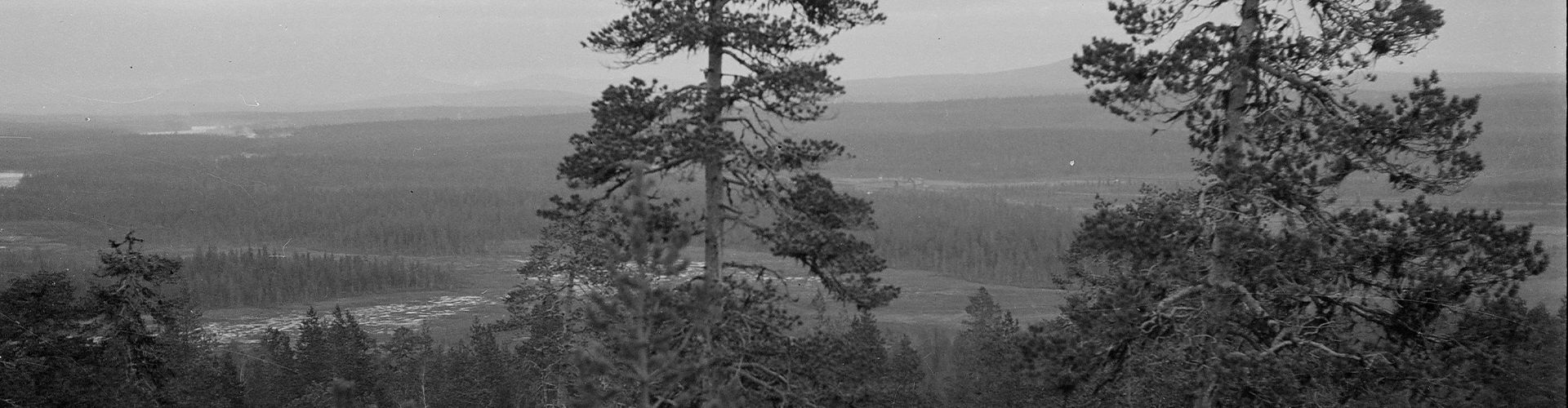
Engineers during the Lapland War
The German 20th Mountain Army, deployed in Finland, started to make preparations to withdraw in early September. A significant number of mines and explosives were distributed to the troops for barrier preparations. Although the withdrawal was initially a scheduled operation, the Germans did not stop destroying the bridges on the retreat routes. This was due to their preparations for the attack by Soviet troops against the Germans which would be through Finnish territory. Finally, the Germans were also preparing to protect their withdrawal by means of barriers in the event of the expected Finnish attack.
The role of clearing barriers, water crossing activity, repairing roads, constructing bridges, as well as maintaining supply routes was emphasized in the Lapland War. To begin with approximately half of the engineer troops of the ground forces were concentrated to the north. After the Finnish army had been demobilized, in the ranks of a division established for the Lapland War, the men born in 1925 and 1924 remained in order to be trained as Reserve NCOs. An engineer battalion and an engineer company, both of which were undermanned, were formed from the divisional engineer troops. The undermanned engineer battalion belonged to a temporay combined arms, named Group Puroma, led by Colonel, Knight of the Mannerheim Cross Puroma.
The tasks carried out by engineer troops
The Germans made barriers on the roads in the direction of advancement of the Finnish troops which were more than of 4,000 kilometres in length. Hundreds of road and railway bridges, as well as culverts of the roads and railway banks had been destroyed. Even the bridges and culverts of the village roads had been blown up. The breaks on the roads had also been made by using explosives, and 24 ferries had been destroyed. The nearby areas of the demolition sites had been systematically mined. Engineers made reconnaissance of the sites of the barriers, marked them and fenced the minefields off. By using goads and mine detectors, the engineers had neutralized 16,000 mines by the end of November. The damaged roads softened by heavy traffic and the season of frost in autumn needed continuous repair work. On roads covered by slush, the repair and mine clearing work was difficult and slow.
The water crossing transport took place firstly by using provisional equipment, punt equipment, and assault boats on the lakes. Secondly, the water crossing artillery transport and supply vehicles began to use pontoon equipment. Thirdly, the construction of a field bridge was started in order to replace the pontoon bridge. Later, in winter, it was also possible to cross the rivers along the ice coat.
The mine clearance in Northern Finland in 1945–1952
Mine clearance conducted by the engineer troops during the Lapland War focused primarily on the nearby areas of the demolition sites on the roads. Clearing works were a necessary prerequisite for the advancement of troops, vehicles and supplies. After the Germans had left Finland, eight mine clearance detachments were established from the engineer troops already deployed in the north, and from those that had been seconded to the area. By mid-July, 15,582 mines, 664 aerial bombs and 5,710 artillery rounds were cleared in Northern Finland. 30 engineers lost their lives and 35 engineers got wounded during those operations.
It was not possible to leave the mine clearance works in the region of the whole of Lapland as the responsibility of peace-time engineer troops. The return of the evacuated civilian population to their homes required special measures. The solution was to use hired personnel and trained volunteers for mine clearance tasks. In June 1945, the newspapers published an advertisement inviting applications for mine clearance tasks. Reserve Officers and non-commissioned officers of the engineer branch of the service registered for the mine clearance course, which began on 19 June 1945. Regular personnel of the engineer troops were also seconded to the course. Apart from engineers, there were also men from other branches of service amongst the 400-men strong mine clearance personnel.
They became acquainted with mine-clearing methods and tools, as well as the mines and methods of mining used by the Germans. The goads and Swedish manufactured mine detectors were methods of locating mines. Moreover, they practiced locating mines using mine dogs. The dogs also assisted in the post-inspection of the clearings. Their sense of smell was able to reveal the mines which had been laid deep and were not detected by goads or mine detectors.
There were 4-7 mine clearance detachments led by an experienced engineer officer in every five mine clearing areas, which belonged to the mine clearance organization. The mine clearers were paid their travel expenses and their daily wage, and they were insured. The mine clearers were given free field accommodation. In view of their dangerous occupation extra money was paid for cleared mines, most for clearing bounding mines. The extra money was divided between all mine clearers belonging to the detachment. They promised that the monthly salary of a mine clearer would be one and a half times higher than that of a Major in active service.
Apart from mines, aerial bombs and artillery shells were cleared. Clearing activity was highest in the summer of 1945. In summer of 1946, the number of mines and artillery shells fell and most of the objects being cleared were artillery shells. Over the 1947-1952 summer times, the clearance work took place with a gradual reduction of manpower and in fewer places. The number of cleared explosives dropped and injured personnel were isolated cases. Most injuries were caused by bounding mines.