
Engineers in Offensive Phase
Facilitating Movement and acting as shock troops
During the offensive phase, the main task of the engineer troops was to support the movement of forces by clearing minefields, obstacles, and barricades, constructing vehicle paths, enabling water crossings, and carrying out road and bridge construction required for logistics. Combat engineers also operated in shock troop detachments, demolishing bunkers and dugouts, storming trenches, and using flamethrowers. Some engineers received training for these tasks even after mobilization, before hostilities began. In addition to engineer units, special units such as bridge-building companies and fortification construction battalions were used for constructing and repairing field, road, and railway bridges.
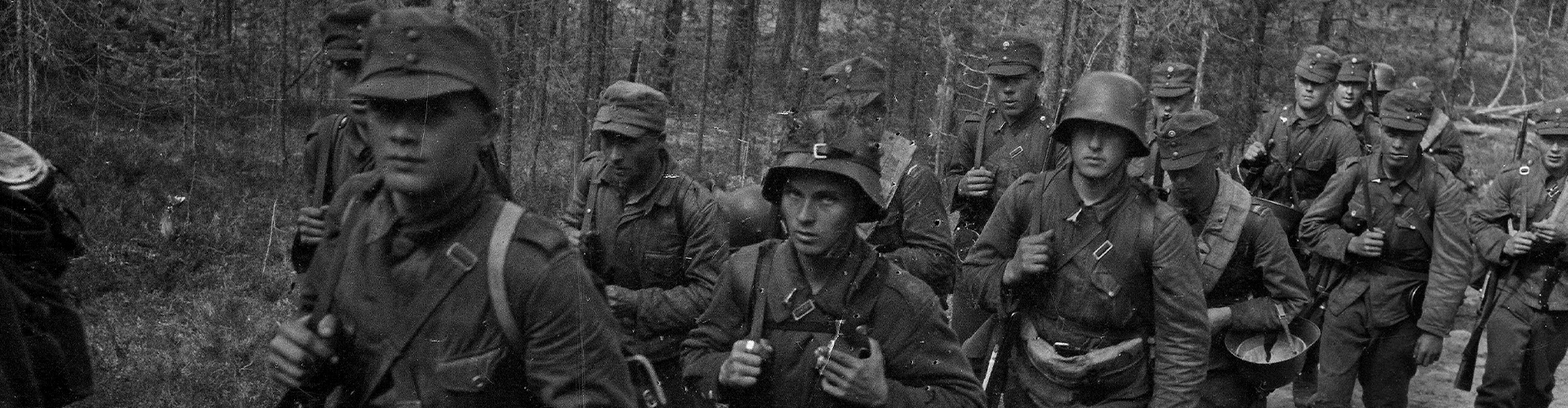
In addition to mobility tasks, engineer troops often had to fight like infantry. Typically, an engineer company advanced with an attacking regiment, with its platoons scouting and clearing enemy obstacles while moving with the spearhead company. During reconnaissance attacks, engineers located enemy positions and minefields. In local offensives, engineers participated in combat patrols to capture enemy-held, rigged bridges intact for the use of friendly forces. In the Ilomantsi region, an engineer company under Group Oinonen encountered heavily fortified enemy positions and bunkers in remote forest areas. To capture these, systematic shock troop tactics were employed, based on the Winter War experiences of the unit’s engineer commander, Captain Reino Lukkari, and training received in Germany. On July 5, 1942, the Commander-in-Chief awarded Major Lukkari the Mannerheim Cross. Another engineer awarded the Mannerheim Cross during the offensive phase was Lieutenant Paavo Koli, who, as an ensign, repelled an enemy battalion's encirclement attempt with his engineer platoon.
When repelling enemy counterattacks, engineer troops constructed anti-tank minefields, which were removed when the situation allowed. Once defensive positions were assumed, a total of 24,000 anti-tank and 92,000 anti-personnel mines were laid across the various fronts. Clearing operations continued after areas were captured. After the Red Army withdrew from Hanko, the city was found to be heavily mined and booby-trapped. Engineer clearance teams removed nearly 20 tons of mines, munitions, and bombs, and defused over 42 tons of explosives. The clearing operations in Hanko continued until the end of June 1942. A total of 17,600 mines and booby traps were rendered harmless.
Water Crossing Operations
Crossing water obstacles was a central engineer task during the offensive phase. Engineer troops carried out river crossings and built and repaired bridges on all fronts from the Karelian Isthmus to Salla. On the Eastern Isthmus, the most significant crossings using ferries and pontoon equipment were made over the Vuoksi River and the Taipaleenjoki River. Two bridges were also constructed over the Vuoksi near Äyräpää. A major crossing was carried out during the capture of Western Karelia over the Bay of Vyborg. On August 23, when a peninsula on the opposite shore was found to be unoccupied, Finnish troops were immediately transported there using log rafts pushed by assault boats, and later by pontoon rafts. The width of the crossing was 2.2 kilometers. In the following days, additional crossing equipment was brought in. During the eight-day operation, more than 9,500 men, over 1,100 horses, nearly 900 horse-drawn vehicles, 41 motor vehicles, 86 artillery pieces, and 610 tons of supplies were transported across the bay. Engineers also had to fight at the bridgehead and fire upon enemy vessels attacking the crossing units.
By the end of 1941, engineer troop accomplishments in the Continuation War included:
- 243,000 mines removed during clearance operations
- 630 obstacles cleared from advancing routes
- 226 charges removed from bridges
- 311 buildings cleared of explosives
- 361 tons of explosives recovered from rigged targets
- 1,680 kilometers of constructed vehicle roads
- approximately 1,800 kilometers of constructed automobile roads
- over 2,500 culverts built
- nearly 25,000 kilometers of maintained automobile roads
- 47 water crossings using assault boats
- 37 crossings using log rafts and other vessels
- 151 uses of log rafts
- 37 field ferries constructed
- 210 pontoon rafts constructed
- 34 log bridges constructed, totaling 1,245 meters; 18 pontoon bridges, totaling 1,318 meters; 870 field bridges, totaling 12.5 kilometers
- 251 field bridges reinforced, totaling 3 kilometers
- six railway bridges constructed, totaling approximately 300 meters