
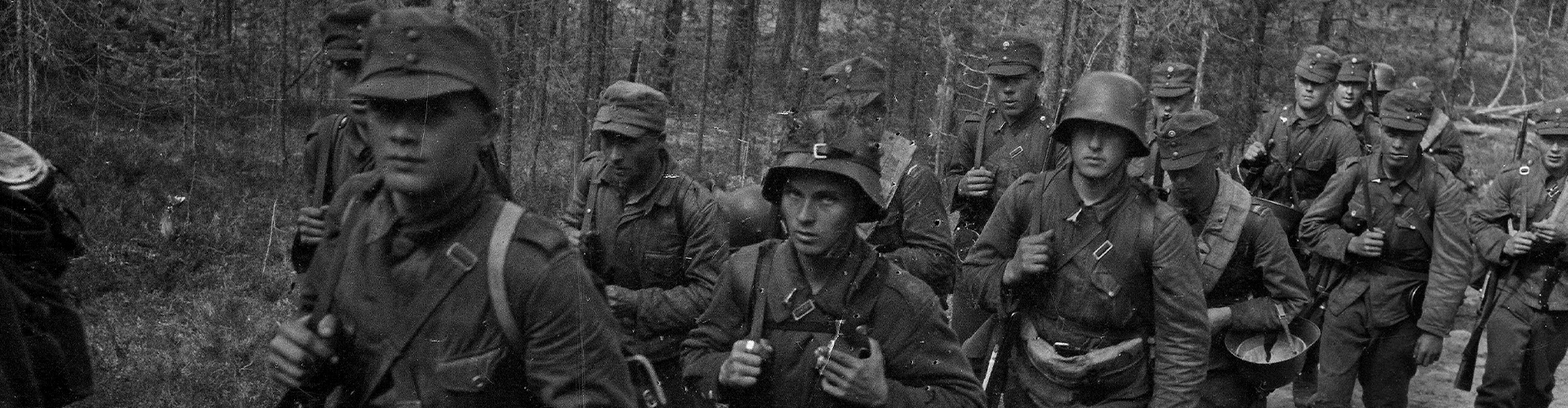
Finnish Artillery in Offensive war
Artillery Troops and Equipment Situation
The field artillery entered the Continuation War in a stronger position than during the Winter War. Thanks to the acquisitions made during the Interim Peace, more artillery units could be established. The supply of ammunition had also improved significantly. Lieutenant General V. P. Nenonen served as the Chief of Artillery at the General Headquarters throughout the Continuation War.
At the start of the Continuation War, a full-strength division included a horse-drawn field artillery regiment and either a horse-drawn or motorized heavy battery, with a total of 48 guns. However, six divisions initially lacked heavy artillery due to equipment shortages. The Jäger brigades had a light battery, and the Cavalry Brigade included a light battery and a mounted battery. In Petsamo, there was also one separate light battery. Fortress artillery belonged to the army corps, while the heavy artillery was subordinated to the General Headquarters. In total, 77 field artillery batteries and four observation batteries were established. The equipment consisted of 52 different gun models and 13 caliber categories. At the start of the war, the artillery had a personnel strength of about 50,000 men.
There were still shortcomings. Artillerymen had modest personal armament, some gun-specific equipment was lacking, and there were few radios. The proportion of heavy artillery had increased, but only one-third of the field artillery was motor-drawn. Six horses were needed to tow a light gun, and eight for a heavy one — a heavy burden in mobile warfare. In the battles of 1941, Finland captured approximately 800 artillery pieces. The major encirclement battle at Porlammi on the western Karelian Isthmus, where three Soviet divisions were surrounded, yielded 200 guns in addition to other equipment.
Artillery in Offensive Warfare
Field artillery supported advancing infantry by delivering preparatory bombardments and providing fire support as needed during the offensive. To break through heavily fortified enemy lines, direct fire from artillery was also used. Unlike in the Winter War, there was no need to conserve shells in the early phases of the Continuation War. Firing could be intense at times, and many gun barrels became worn and needed repair.
Offensive warfare posed many challenges for the field artillery. Infantry operations often involved long flanking maneuvers that artillery struggled to follow. Particularly north of Lake Ladoga, the road network was sparse and often in poor condition. The relatively short range of most artillery forced frequent and difficult repositioning. Staggered battery-level movements often prevented batteries from functioning as coherent fire units. Organizing ammunition supply for a mobile force with a wide variety of gun types was a demanding task. Rapid advances also made it difficult to establish communication links. Due to the scarcity of radios, fire control during offensives still relied mostly on telephone lines. However, there was also a shortage of field cable. As a result, forward observers could fall behind the infantry when cable ran out. As the advance north of Lake Ladoga continued into autumn and early winter, the conditions further hampered artillery mobility. On the Karelian Isthmus, Finnish forces had already assumed defensive positions by September.