
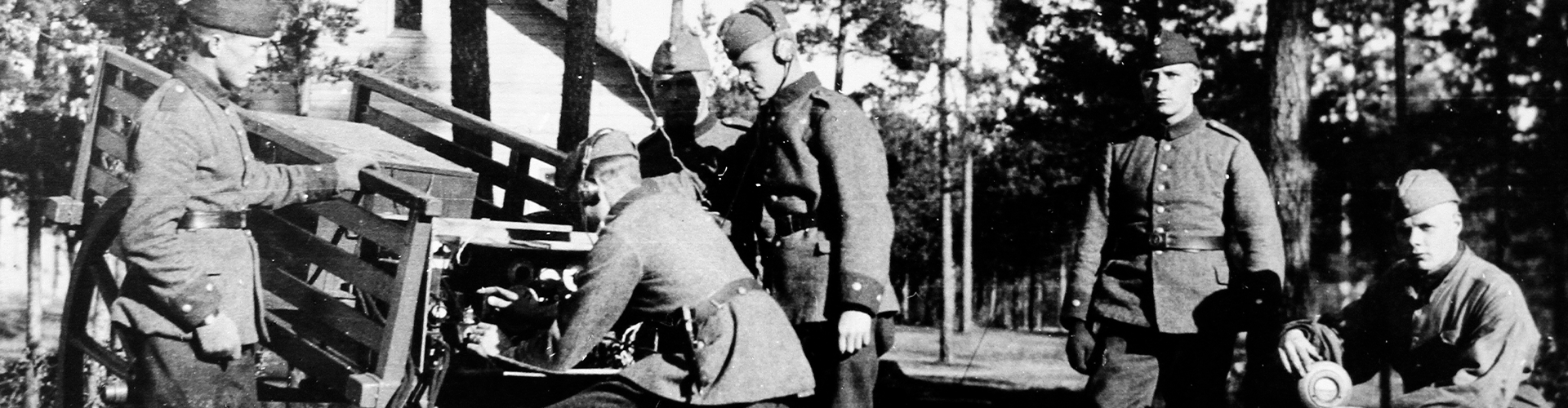
Finnish Defence Forces in the 1920s and 1930s
The years after independence were a time of formation and organisation of the Finnish armed forces.
Development of the conscript army
Already during the civil war, a conscription proclamation had been issued under the Conscription Act of 1878. In January 1919, the old law was reformed. The Provisional Conscription Act, which was enacted at that time, provided for a period of one and a half years of conscription. As regards the training of conscripts, it was stated that the aim was to form 'a fighting force capable of all the tasks assigned to it and always ready to perform them, even if they required a great deal of sacrifice'.
Despite conscription, it was initially associated with a certain voluntary nature, which led, for example, to conscientious objection. After the Civil War, the army's severe shortages of material and poor conditions came to the fore. The losing side of the war had strong prejudices against the army. However, conscription and the reserve army became the basis of the independent Finnish army.
In 1922, a new Conscription Act was enacted, which set the general length of service at one year. As early as 1919, Parliament had proposed that the period of conscription should not exceed one year, in order to get manpower back into the civilian world as quickly as possible. However, the length of service for cavalry, technical troops (engineers, signal troops and artillery) was set at 15 months. The same period was also applied to those training to become non-commissioned officers and reserve officers. In 1932, the Conscription Act was reformed, setting the general length of service at 350 days for enlisted men and 440 days for reserve officers and non-commissioned officers.
In the 1920s, only reserve officers and non-commissioned officers were subject to recurrent training. Refresher training for the crew began in the 1930s. The conscription system was significantly supported by the work of the Guards.
The Officer Revolt
In the early years, the army's internal conflicts were caused by different political orientations and officer backgrounds. The officer corps consisted of soldiers who had served in the Russian Imperial Army, those with a Jaeger background and those who had been trained in Finland during independence. The most senior posts were held by the most experienced officers who had served in the Russian Imperial Army. The disputes culminated in the so-called officers' revolt of 1924. The officers threatened to resign if their demands for the dismissal of 'Ruskie officers' from their senior posts were not met. The reason given was distrust and perceived shortcomings in the defence establishment, but mainly due to the poor economic situation and political decisions. In the end, many officers who had been trained in Russia resigned or were transferred to secondary posts. By 1926, the Jaegers had risen to the highest rank in the defence establishment.
From Cadre System to Regional Mobilisation
From 1919 onwards, the Finnish mobilisation system was based on a so-called cadre system, in which peacetime troops were responsible for forming the bulk of the wartime forces. This meant that very large numbers of men, horses and material had to be assembled in garrisons. The system was slow and vulnerable.
A major reform in the 1930s was the move to regional mobilisation, whereby wartime forces were established according to a regional establishment plan. Responsibility for the establishment of a wartime field army was transferred to the military provinces and districts. The system relied heavily on the activities of the Civil Guard. The peacetime force's role in the system was to act as a protective force. The territorial system was unique to Finland in its time.