
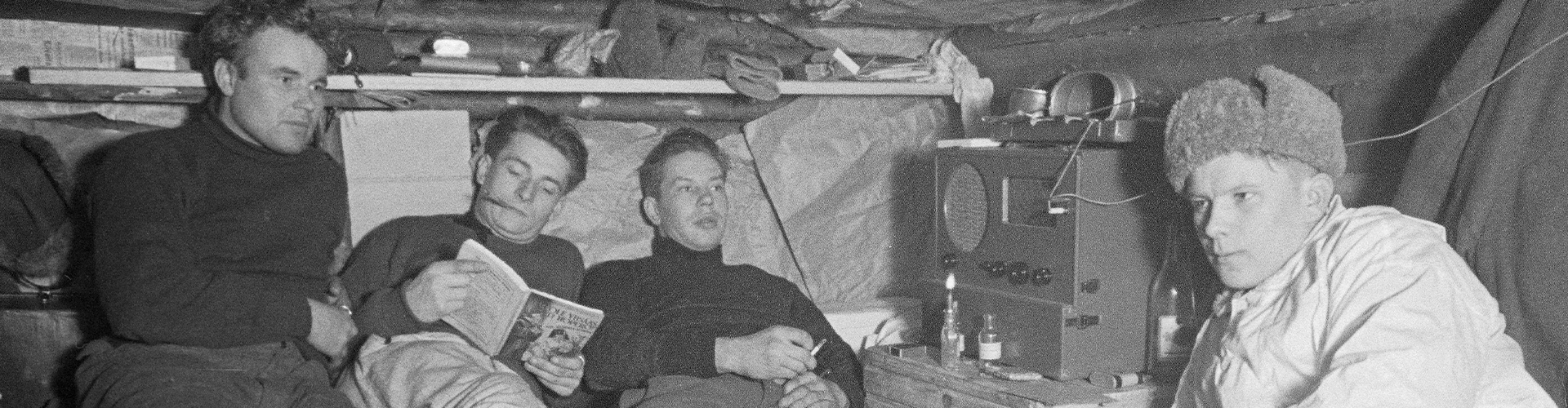
Signal troops in Trench Warfare
Maintaining connections
When trench warfare began, most field cable lines were dismantled and replaced with open wire or field open wire lines. This conserved field conductors for future mobile operations and improved the audibility of communications that had become extended over long distances. During trench warfare, the aim was often to extend the fixed telephone network all the way to the frontmost strongpoints and outposts, which required substantial amounts of material. In addition to meeting their own telephone pole needs, the troops produced thousands of poles for the home front during the trench warfare period.
The main task of the signal troops during trench warfare became the maintenance and repair of rear-area wired communications. Building the communication network within the actual front-line zone was the responsibility of the front-line units’ own signal detachments.
Field radio communication was primarily done via encrypted Morse code messages. Although most radio models were capable of transmitting voice even during the trench warfare phase, this was avoided due to the risk of enemy interception and the shorter communication range. Because encryption was time-consuming, the use of field radios was limited, and reliance on field telephone connections remained high. However, these telephone lines were easily damaged by intense artillery fire.
During trench warfare, signal troops also became responsible for electrical power supply. Command posts and even some front-line dugouts were equipped with electric lighting, which required and consumed large amounts of materials.
Signal Training
During the Continuation War, the training and reinforcement of signal personnel were handled by signal training centers located in Sammaljoki, Karkku, and Santahamina, and later also in Urjala. Activities of the Signal School, which had been interrupted by the war, resumed in Hämeenlinna in 1943–1944. The school was renamed the Army Signal School, as the Air Force Signal School had also been established in Hämeenlinna in 1942.
Signal Intelligence (Radio Intelligence, Ground Listening)
Radio intelligence formed its own specialized branch of wartime signal operations. The activities were initiated by Lieutenant Reino Hallamaa when he was assigned in spring 1927 to the General Staff to develop the field of radio intelligence. In the years preceding the wars, he trained personnel and procured equipment, enabling significant results to be achieved even during the Winter War. During that war, radio intelligence was the responsibility of the General Headquarters’ Radio Intelligence Company. With the mobilization for the Continuation War, the General Headquarters established a Radio Battalion for this purpose, which eventually evolved into a specialized signal intelligence unit consisting of seven base units. At its peak, the battalion had about 1,500 personnel, one-fifth of whom were women.
The battalion’s headquarters operated in Mikkeli as part of the General Headquarters’ Intelligence Division’s Signal Intelligence Office, with Hallamaa serving as both the office chief and battalion commander for nearly the entire war. The battalion's seven base units included intelligence units for the army, navy, and air force; a mobile unit called “Moto” with teams deployed across the front; battalion radio stations responsible for, among other things, monitoring long-range patrol communications; a diplomatic radio traffic monitoring unit; and a depot company responsible for developing and acquiring the battalion’s equipment. The naval intelligence unit later became Radio Intelligence Center 3, and the air force unit became the Air Force Radio Battalion.
The personnel of the Radio Battalion were selected from radio operators trained in the signal troops as well as radio amateurs, who made up about a third of the radio intelligence recruits. Additionally, linguistically skilled men, mathematicians, and researchers were assigned to the unit and trained in relevant duties. The battalion’s equipment developed and expanded from the late 1930s, as Major Hallamaa successfully acquired high-quality receivers and radio vehicles, mainly from Sweden. The primary receivers used were American National NC-100XA communications receivers. The battalion’s own depot company also functioned effectively as a development center and production facility, manufacturing various materials for radio intelligence needs.
In addition to radio traffic, some telephone lines were also monitored during the wars either by tapping directly into enemy lines in the rear area or by listening to ground currents generated by single-wire lines used by the enemy. These currents could be amplified with ground listening amplifiers to make them audible.