Viestijoukot ja -koulutus
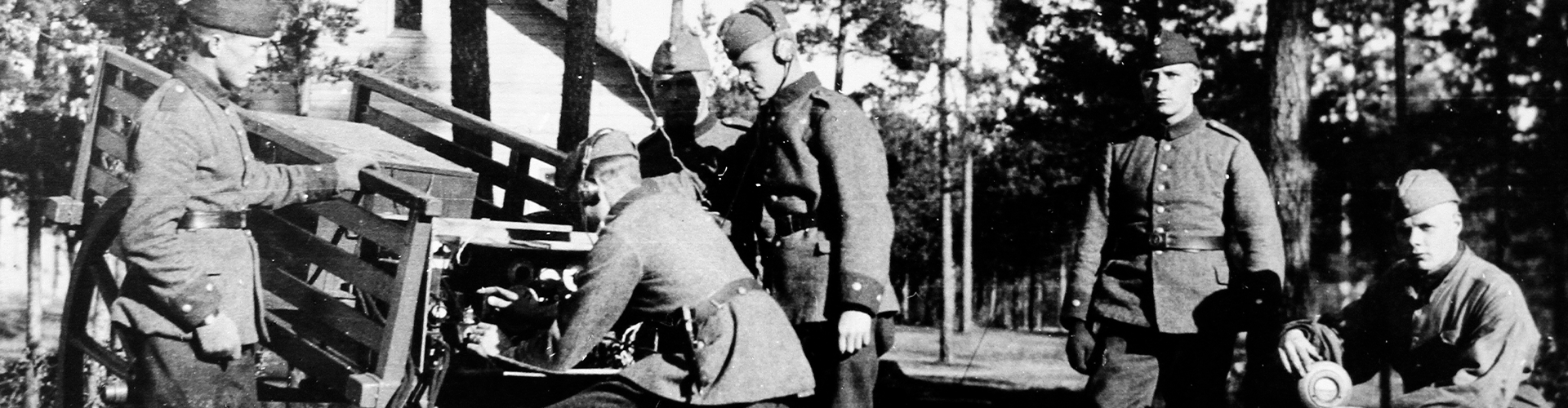
Finland's first peacetime Signal troops were established by General Staff Army Order No 39 of 5 August 1918, which ordered the creation of four Signal companies as the Signal troops of the three divisions and the Jaeger Brigade formed after the Civil War. The creation of the divisions was intended to maintain readiness by training divisions almost entirely in wartime formation.
In 1920, the signal troops were transferred to Riihimäki and merged into the Field Telegraph Battalion. Captain Leo Ekberg was appointed commander. The battalion mainly provided training in the telephone and telegraph service, with the main emphasis on building and maintaining telephone and telegraph lines.
The creation of Field Telegraph Battalion allowed more resources to be concentrated on signals training. While dispersed in to the divisions, the signal troops and their needs for equipment were neglected. In 1928, one of the companies of the Field Telegraph Battalion was formed into a separate Field Telegraph Company, which was transferred to Viipuri.
After the Civil War, the radio equipment received from the Germans and captured from the Russians was assembled in Helsinki, where the Military Radio Command was established. In the summer of 1918, the Radio Command and the Telegraph school, which had been transferred to Helsinki, were merged into the War Department's Radio Telegraph Section, headed by Captain Arthur Stenholm. In 1919, the name of the unit was changed to Radio Telegraph Section, in 1920 to Radio troops and finally in 1924 to Radio Battalion. The main part of the unit was based on the island of Santahamina, the rest on Katajanokka in Helsinki. In addition to military training, the detachment was responsible for the operation of the fixed radio stations of the Defence Forces.
Until 1925, the radio detachments were also largely responsible for the launch of general radio broadcasting in Finland. Radio stations on warships, civilian ships and icebreakers were subordinated to the radio troops. They were also responsible for training radio operators for the Telegraph Board, the Maritime Administration and the merchant fleet. The staff of the units also contributed to the establishment of amateur radio and broadcasting in Finland.
In 1930, the Radio Battalion and the Field Telegraph Battalion were harmonised so that both began to provide both radio and telephone training. At the same time their names were changed to Signal Battalions. The Radio Battalion became Signals Battalion 1 and the Field Telegraph Battalion became Signals Battalion 2. In 1934, all communications units were transferred to Viipuri, where the Signals Battalion was formed. Colonel-Lieutenant Arthur Stenholm, from 1935 Saarmaa, was appointed commander. Due to its large size, the battalion was reorganised and renamed the Signals Regiment in 1938.
The officers and non-commissioned officers who served in the Signal troops received their training, initially in the form of communications courses organised when required in the units. From 1934 onwards, training took on a more established form. The Signals Battalion and the Signals Regiment had a signals course and a training workshop. In addition to the actual signals troops, conscripts were also given communications training in several other branches of the armed forces and in the air and naval forces.
Until the Winter War, all technical forces were under a common command. The forces in different locations were headed by a commander of the technical forces, from 1927 onwards by a technical inspector. Until the Winter War, this post was held by Major General Unio Sarlin, who had a background as an engineer. The signals sector only became an independent branch of the armed forces on the eve of the Winter War in October 1939. Colonel-Lieutenant Leo Ekberg was appointed as the first inspector of the branch.
col-sm-6