
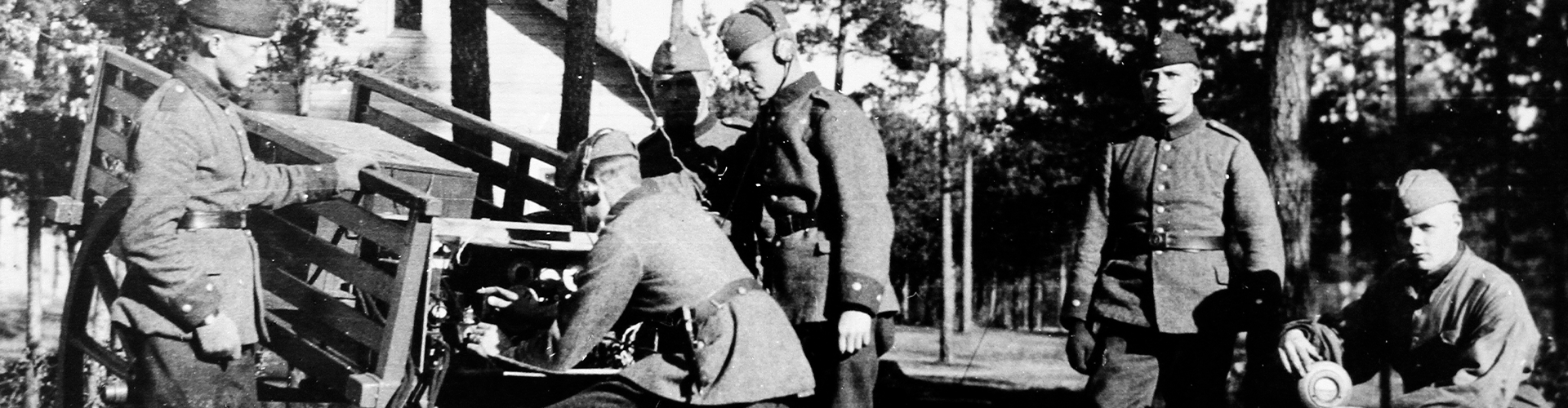
Signals equipment
Initially, the equipment of the Signal Corps was limited and its performance modest. During the 1920s, field cables, telephones, switchboards, telegraphs and radios were mostly material brought from Germany and left in Finland by Russian troops. In the early 1930s, the situation was significantly improved by telephone and telephone exchange equipment purchased from the Estonian Tartu Telefoni Vabrik.
As the radio equipment from the Germans was not suitable for Finnish conditions in terms of size and mobility, and as the technology based on spark transmitters and crystal receivers was outdated, the radio workshop of the Radio Battalion developed field radio types suitable for Finnish conditions. Before the war, several hundred of them were produced in Finnish factories.
The models used some of the same materials, components and wiring diagrams. Later, this series of radios became known as the old B-radio, or division radio, the C-radio, or regimental radio, and the D-radio, or fire control radio or artillery observer radio.
The 1926 defence revision emphasised the importance of telephones as the main means of communication, but it was also considered necessary to acquire radios, especially in view of the challenging terrain in Finland. The revision's emphasis on telephone command was probably due to the lack of radios and the limited experience of using them.
Labelling of the equipment
The first proper system of labelling of signals equipment was introduced in the early 1920s. This was a system of depot signs, the so-called P-signs. The marking of an individual object was expressed as P-00-00. The P was the designator of the item, the first series of digits indicated the type of equipment and the second was a consecutive serial number.
Additional letters could also be added at the end of the item for clarification purposes, to distinguish between different versions of the same item. For example, the letter 'u' at the end of the heading indicated radios operating at ultra-wave frequencies (above 30 MHz) in the case of radios and a new model in the case of telephone equipment.
Digits indicating the type of equipment:
| 1 | field telephones |
| 2 | field exchange equipment and switchboards |
| 3 | field cables |
| 4 | power sources |
| 5 | meters, gauges, indicators |
| 6 | tools |
| 7 | flare guns and flares |
| 8 | beacons and semaphore flags |
| 9 | line construction equipment |
| 10 | telegraphs |
| 11 | cables |
| 12 | radios |
| 13 | flashlights |
| 14 | spotlights |
| 19 | transportation cases for signals equipment |
| 30 | transportation cases for high-voltage equipment |