
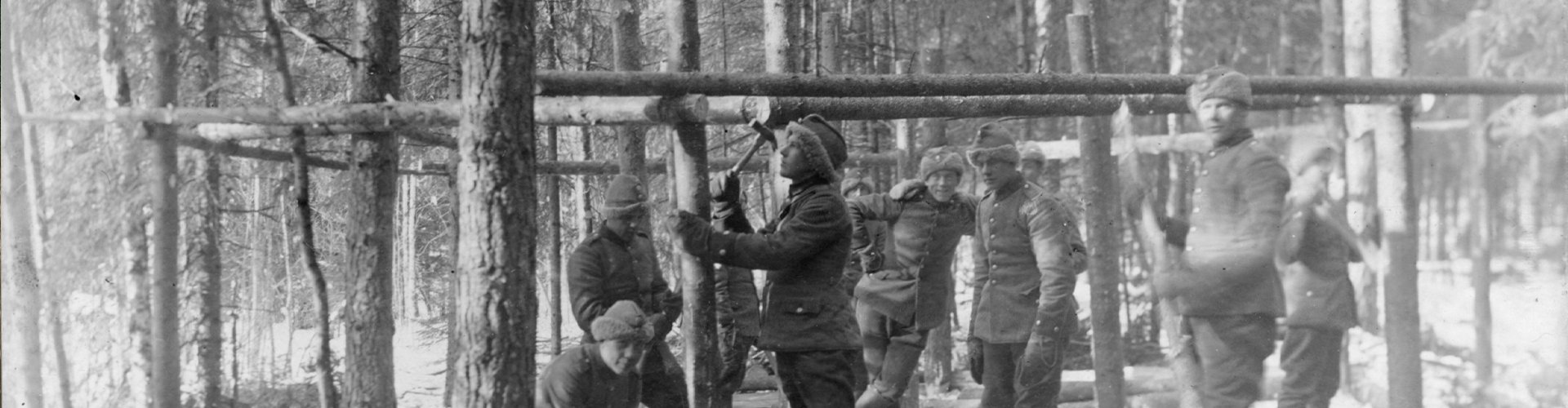
The many experiments carried out by the engineers in the 1920s and 1930s focused on their own equipment and methods of operation, but also on equipment that benefited other branches of the armed forces.
Fortification experiments
In the 1920s, fortification experiments were carried out to develop the types of fortifications and working methods best suited to Finnish conditions and equipment. In the summer of 1923, the Engineer Battalion built various model forts in the Parola, Utti and Lappeenranta training areas. During the summer of 1924, a series of fortification trials and test firing were carried out at the Perkjärvi artillery camp. The aim of the shooting was to observe the effect of artillery fire on the field fortifications built on the firing range. The fortifications withstood the fire of the test firing.
Commander of the Engineer battalion Major Lauri Stark, confident in the durability of the fortifications built by his battalion before the shooting, offered to stay inside the accommodation barracks, described as "bomb-proof", during the trial, but was not allowed to do so.
The fortification experiments carried out were important for the engineers, as they laid the foundations for training. Throughout the 1920s and into the early 1930s, the training of the engineers was mainly fortification training.
In its own barracks area in Koria, the Engineer battalion built over the years what were known as model fortifications, whose structures and their finer points were demonstrated to visiting officers and troops from nearby garrisons.
One of the most unusual of these model stations was the disappearing machine-gun nest, which Captain H. Uimonen developed in 1926 on the basis of an idea from Major Stark. Built in an open pit, the machine-gun station, the roof with a layer of camouflage and the machine-gun table itself could be raised simultaneously by means of a lever to such a height above the ground that the fire could be opened unexpectedly, for example, on the other side of a sloping hill. When the station had completed its task, the levers were released and the gun and its table and the station and its roof disappeared from view.
Experiments related to roadworks and mobility
The Engineers actively participated in experiments on both vehicle winter mobility and road ploughing. These experiments were carried out together with the Motor Battalion, which was, just like the engineers, part of the Technical troops.
Winter roads were at the heart of the experiments in the 1920s. Experiments included various horse and tractor tracks, ploughing methods and the freezing of roads for winter use. However, some of the innovations developed did not prove feasible. For example, a plough that was to be pushed by a horse in deep snow. The horse refused to push the plough.
Attempts were also made to experiment with mechanical methods, but there was no possibility of large-scale purchases in the 1920s and 1930s. Among the tools tried were pneumatic road drills, crushers and road graders.
col-sm-6
Demolition experiments
Demolition operations were also actively experimented with in the early years of independence. The blasting formulas and charging principles of German demolition guides were found to be suitable for Finnish use. However, they were designed for trotyl (TNT), which was at the time a rare military explosive in Finland in the 1920s and difficult to obtain. There were significant quantities of proxylene and dynamite in stock, so the formulae were modified for them.
Blasting experiments showed that the placement of the charges had a significant effect on the effect achieved. Ideally, the charge had to be placed inside the target and covered. It was also advantageous if the structure of the target allowed for rapid placement and attachment of the charge. In 1923, the Technical troops drew up a proposal to the General Staff to equip railway bridges with special equipment to facilitate rapid destruction and a mine chamber, and to equip road bridges with a mine chamber. The realisation of the need for structural preparation for demolitions in peacetime was thus already born in the 1920s.
col-sm-6