
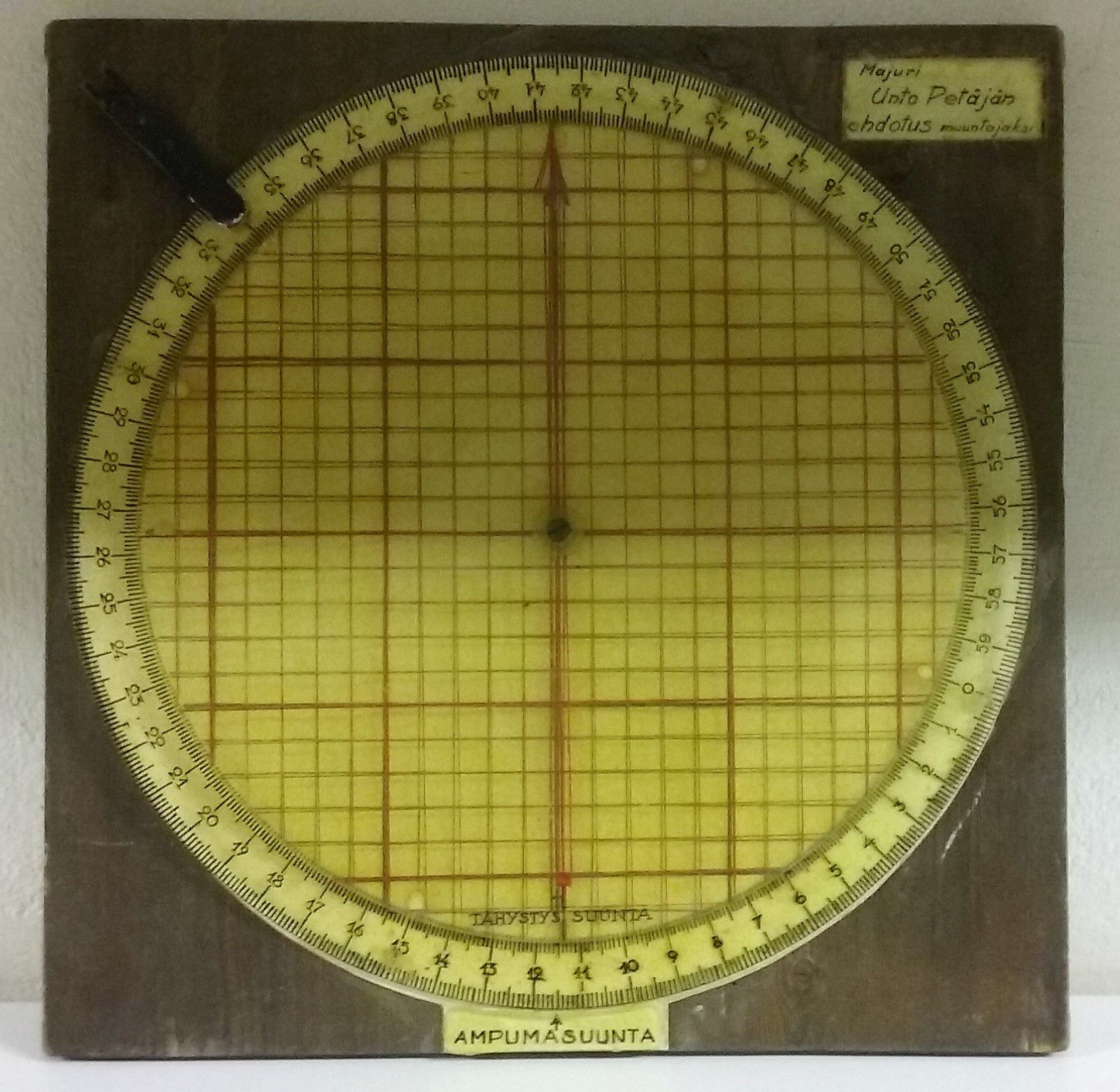
Correction converter
Use of the Correction Converter
For fire correction, the observer informs the battery officer or artillery battalion officer of his observation direction in hundreds of mils, rounded. When correcting fire, the observer commands both lateral and range changes in meters relative to his observation direction, so he does not need to know the battery location or firing direction. He converts the lateral deviation measured in mils to meters by multiplying the observed number of mils by the observation factor, i.e., the observation distance expressed in kilometers. For example, the first lateral fire observation in search fire was 240 mils to the left and ahead. In conjunction with the target determination, he had determined the distance from the fire command post to the target as 800 meters, so effectively to the battery he commands "left 190, continue 200." Both numbers directed to the battery are thus in meters.
The battery chief (battery officer) converts the corrections commanded by the observer relative to the observation direction into lateral and range corrections for the battery using the correction converter. The correction converter has a base plane whose grid represents battery and range corrections in meters on a scale of 1:2000. Then there is a transparent, circular observation disk whose grid represents the corrections made by the observer relative to his observation direction in meters on the same scale. Additionally, a vertically movable lateral direction plate is set, which shows how many mils the lateral correction to the battery is at the given firing distance.
The converter is set to the correction position so that the reading on the edge of the observation disk corresponding to the observation direction matches the reading indicating the firing direction, the tens of mils visually estimated. This way, the sight is set to an actual target angle. To facilitate finding the firing direction reading, an arrow and plus and minus signs on both sides are marked on the base direction on the plane. The lateral direction plate is set so that the reading corresponding to the topographic firing distance is at the upper edge of the plane.
When the observer commands corrections, the battery officer sets, for example, a pen on the observation disk grid using an imaginary impact point as the center at the location required by the command. Then he looks along the plane’s firing direction and reads from the plane’s grid how many meters the distance must be changed to reach the obtained point. Then the pen is moved from that point along the plane’s vertical lines to its edge, and from the lateral direction plate, the lateral correction for the battery in mils is read.
This can be reasonably called a "world invention" in its time in firing technique.
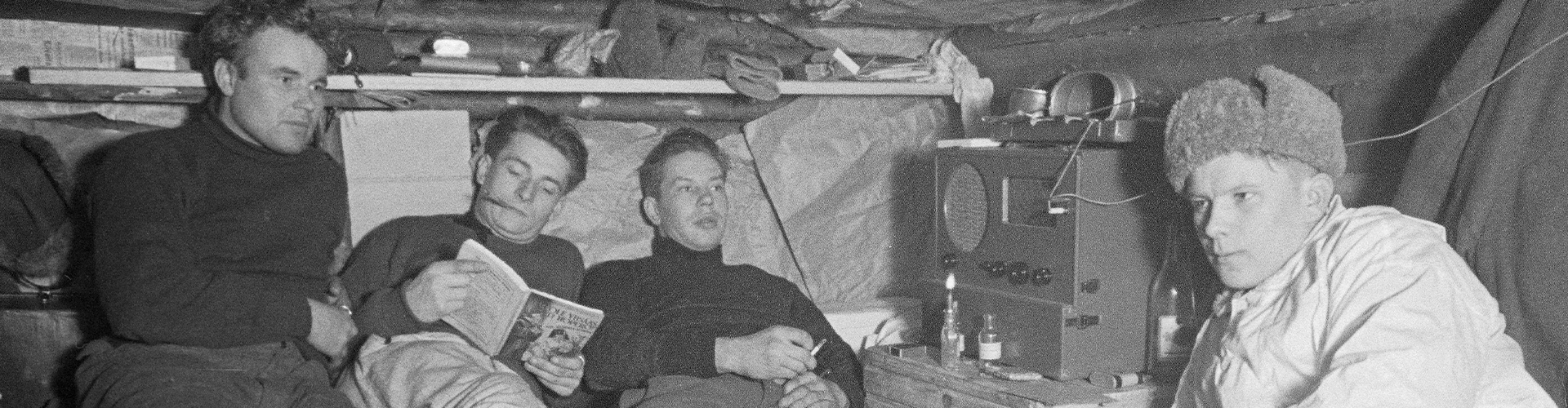
While working as a firing instructor in Suvi-Kumsa, I calculated the accuracies of the firing methods used by our artillery at the time. At the same time, I considered ways to facilitate the work of observer fighting in difficult frontline conditions. It occurred to me that the observations made by the observer about the deviation of his fire (impact center) from the target could be converted into corrections relative to the firing direction of the battery. I taught the method I developed to the students of the Artillery Firing School and tested it in the school's live fire exercises. In this development work, I had excellent support from the artillery commander of the Maaselkä Group, Colonel Eino Honko, who was a very professional and open-minded artillery officer. The Artillery Firing School was subordinated to Colonel Honko.
Colonel Honko told about my invention to Artillery General V. P. Nenonen during his visit to the Headquarters. The highly respected General Nenonen invited me to Headquarters where I presented the correction converter to him. The artillery general immediately recognized the benefits of using the correction converter.
- Captain Unto Petäjä, developer of the correction converter
Development of the Correction Converter
The most revolutionary artillery firing technical invention during wartime was made at the Artillery Firing School in Suvi-Kumsa.
Artillery General Nenonen mentions this invention in his memoirs published in Uusi Suomi in 1957 and later also in a Swedish military periodical:
“… It was customary to invite artillery commanders of army corps to Headquarters from time to time to discuss artillery matters. After presentations in these events, opinions were exchanged, with the artillery inspector finally giving his own statement. In one such meeting, Colonel Honko gave a presentation and made a proposal on how the observer should proceed to shift or correct the fire concentration if necessary. As my final opinion on the presentation, I said it was desirable to try to solve the matter, but I considered the proposed method too complicated. That same evening, I began to consider the matter.
As a principle in the arrangement of firing, I had considered among other things that the observer should be freed from calculations as much as possible so that his main attention could focus on the target itself and the events nearby. Calculations and other details had to be carried out at firing positions and batteries. This led thinking in the right direction. For the observer, it was easiest to give his firing command for correction as if all the guns were beside him. If he also reported his observation direction in his fire command, the batteries had sufficient information to change the firing command so that the fire command would be implemented. The batteries themselves could temporarily prepare this device. The next morning, I explained the method at a meeting of artillery commanders…”.
Colonel Matti Alajoki in his book "Artillery General Vilho Petter Nenonen" mentions the following about the same matter: “… Without doubt the most far-reaching of Nenonen’s artillery technical reforms during the war was the change of the fire command method. Bracketing according to the firing line had proved difficult to perform in frontline conditions. The troops had sent several proposals for improvement to the artillery section of the Headquarters. Thus, in a meeting arranged for artillery commanders of army corps at Headquarters, Colonel Eino Honko was tasked to present a subject touching this matter, fire transfer. He probably got inspiration for his proposed solution from research concerning the matter by an instructor at the Artillery Firing School operating in Suvi-Kumsa. Nenonen considered the matter important and requiring a practical solution. However, he found the method presented by Colonel Honko complicated. After a day of negotiations, Nenonen withdrew to his room and began developing a solution himself…”.
Finnish artillerymen had, until 1993, the firm belief that the correction converter, like the fire command card, was solely Nenonen’s invention.
Who invented the correction converter?
During the Continuation War, the Artillery Firing School was established in Suvi-Kumsa, located in the rear of the Maaselkä Isthmus, providing advanced training for both regular artillery officers and reservists. The school had a training battery and its teaching staff was composed of experts in the field. Lieutenant Lauri Meriluoto, then teaching meteorology at the Artillery Firing School in Suvi-Kumsa, once in early 1943, at his actual post in the Maaselkä Group headquarters, heard that the firing instructor of the Firing School, Major Unto Petäjä, had made a significant artillery technical invention. When Meriluoto later met Major Petäjä, he brought up the matter: "… after giving students’ test results, I congratulated him on the invention, of which I already knew the basics. Petäjä was apparently a bit surprised that I knew quite a lot about the development of the correction converter…”.
The development of the correction converter was an evolutionary and gradual work over several years. Although the idea, concept, and initial construction came from Major Petäjä, the school teaching staff as a whole, including Lieutenant Meriluoto, were involved in the work. Lieutenant Meriluoto recalls that the first rudimentary drawing of the correction converter was drawn on a sheet of paper, probably at the time when Major Petäjä was teaching the students.
“Major Petäjä was a very professional artillery officer with good organizational skills. He got his idea after considering the use of the observation factor in fire correction, leading to the solution he developed for the correction converter.”