
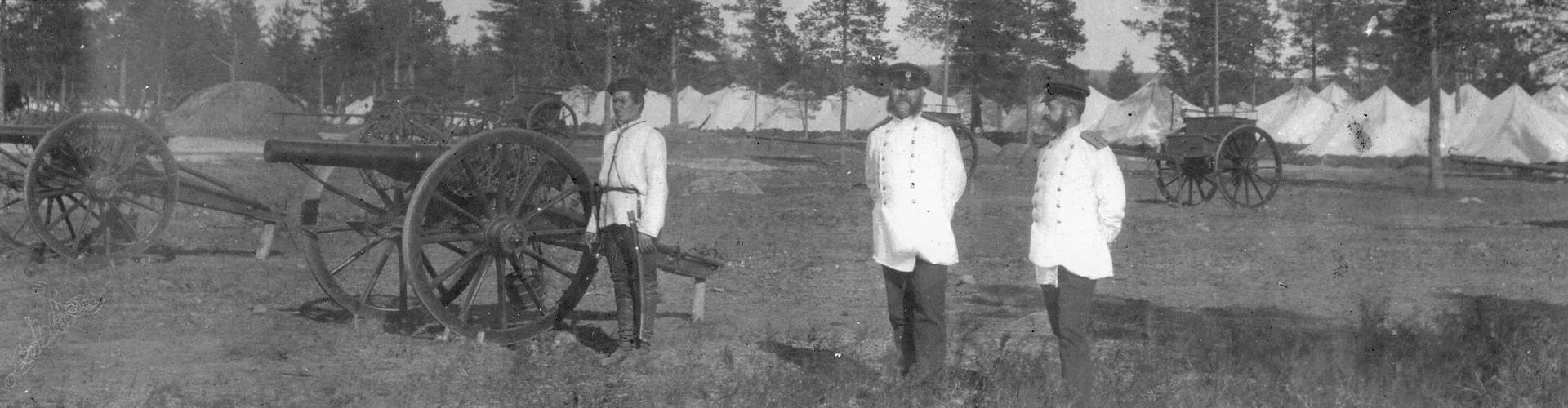
By the beginning of the 19th century, the basic design of the cannon had remained structurally almost unchanged for some three hundred years. Cannons were smoothbore, muzzle-loading weapons mounted on rigid wooden carriages.
During the first half of the 19th century, rifled rifles became increasingly common throughout Europe. Rifling imparted a spinning motion to the cylindrical projectile around its own axis, increasing both range and accuracy. By the middle of the century, the rate of fire, accuracy, and range of breech-loading rifled rifles were sufficient to make the operation of artillery increasingly difficult. The most effective forms of field artillery fire, canister and grapeshot fired at close range, lost much of their importance because riflemen could remain beyond the effective range of the guns.
Rifling
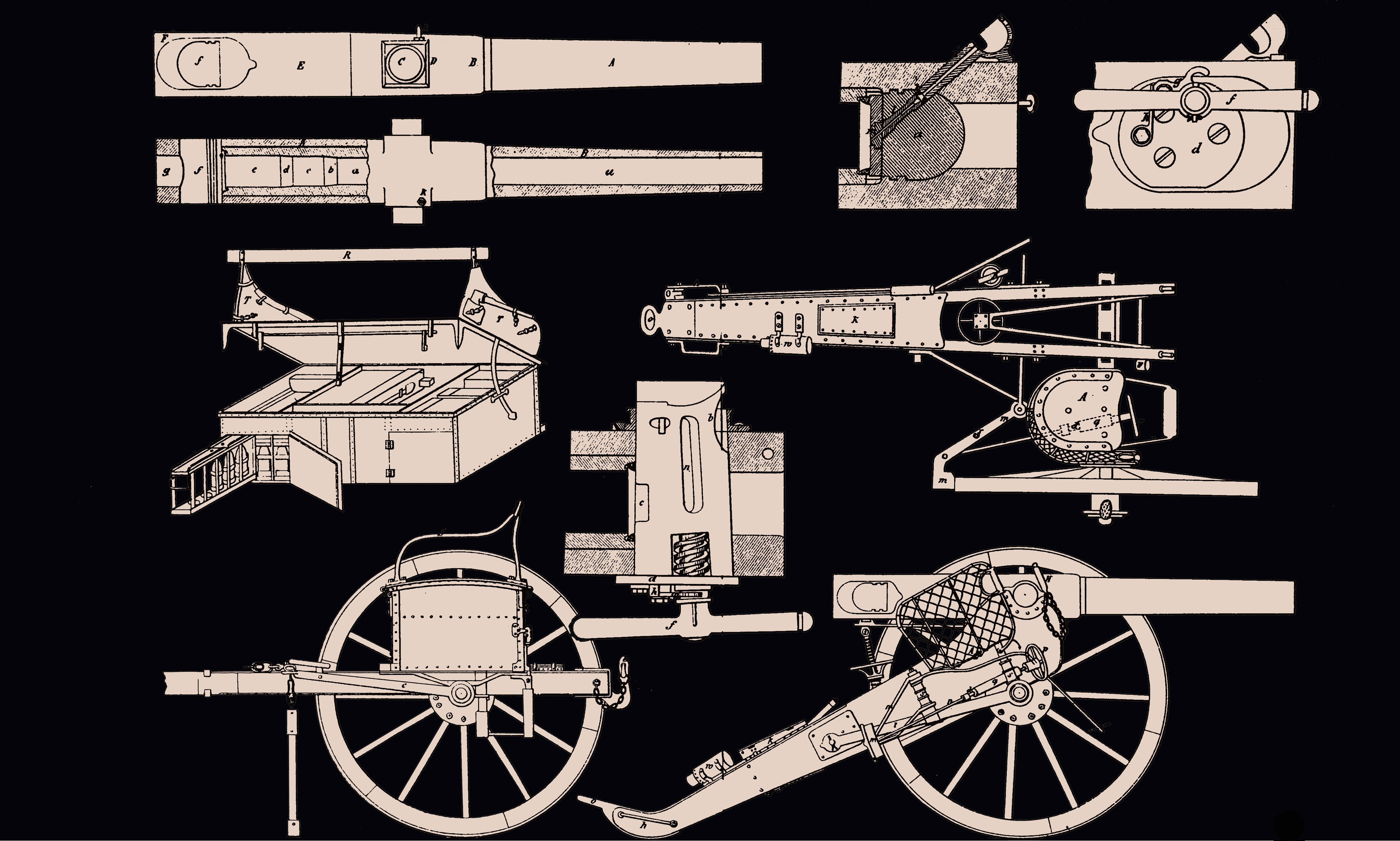
Artillery began to develop in the same direction as infantry firearms. However, cutting rifling into cannon barrels was difficult, as was fitting the projectile tightly enough within the bore. Various rifling systems were employed, and the number and pattern of grooves varied. France in particular focused on rifled artillery barrels while retaining muzzle-loading designs. Early projectiles were fitted with studs that engaged the grooves when loaded. Later, projectiles were equipped with copper driving bands that expanded tightly into the rifling.
Breech Mechanism
In addition to rifling, artillery designers sought to make cannons breech-loading. Since the 15th century, so-called chamber guns had been manufactured, in which a separate powder chamber was wedged into the main barrel. However, the design could not be made sufficiently gas-tight, and chamber guns gradually fell out of use. Breech-loading therefore required a reliable sealing mechanism and breech closure. The first successful artillery breeches used wedge-lock systems. In 1864, the screw breech was introduced in France and rapidly became widespread.
Ammunition
Changes in cannon design also affected ammunition. Spherical projectiles were replaced by elongated shells, and impact fuzes were developed for explosive projectiles.
Gun Carriage
The wooden carriage was replaced by an iron carriage, which nevertheless remained a rigid structure. When firing a gun mounted on a rigid carriage, the weapon had to be repositioned and re-aimed after every shot. Various methods were employed to control recoil, including rope and cable brakes, inclined ramps (ramp carriages), and flexible trail-spade arrangements. These semi-recoil systems, however, did not perform as expected. It was not until 1897 that the first true recoil carriage field gun, the French 75 mm Model 1897 (Canon de 75 modèle 1897), was introduced. In this design, the barrel recoiled along rails in a cradle mounted on the carriage, while the carriage itself remained stationary. The recoil carriage also made it possible to mount a protective shield on the carriage to protect the gun crew from small-arms fire.