
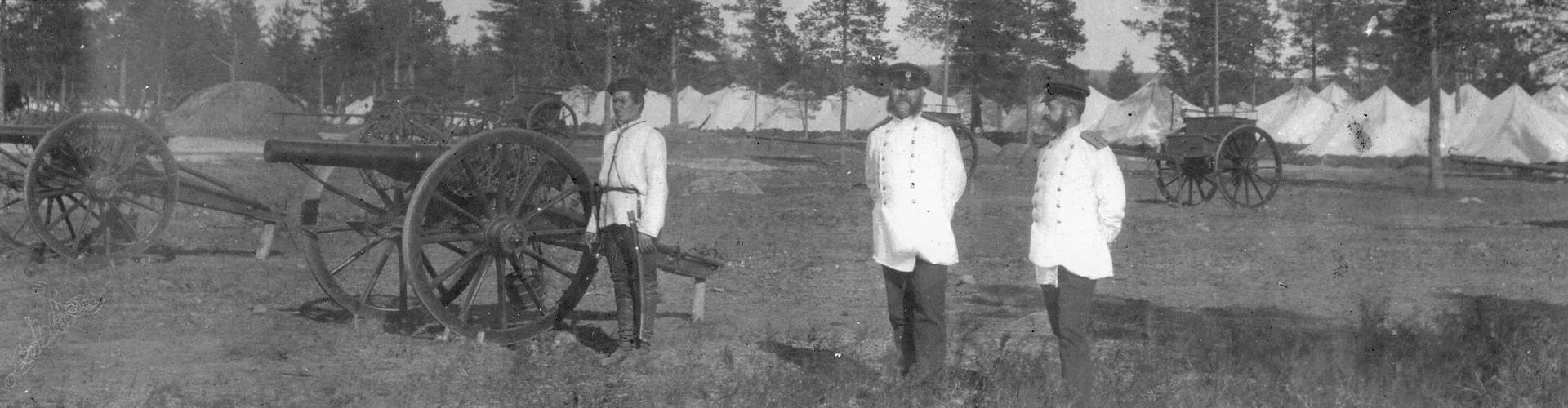
The Military Forces of Autonomous Finland or the Old Guard
During the period of Russian rule, Finland maintained its own national military forces, although their methods of recruitment and organization varied over time, ranging from enlisted units to conscription-based forces. Throughout the entire period of autonomy, however, there were always more Russian soldiers stationed in Finland than members of Finland’s national forces. The Finnish military also lacked certain branches, such as artillery and engineer units, which remained under the control of Russian troops.
In 1812, Emperor Alexander I ordered the formation of three national enlisted regiments in Finland. Although enlistment was officially voluntary, vagrants and other unattached individuals were also recruited by force. The units spent much of the year dispersed and assembled only during the summer for training. In 1827, the regiments were reorganized into rifle brigades. Two years later, the Finnish Training Rifle Battalion, originally established for future officers, became the Finnish Guard Rifle Battalion of the Imperial Guard, commonly known as the Finnish Guard. With the exception of the Guard, all Finnish military units were disbanded in 1830.
When the Crimean War threatened Finland’s coastline, the formation of rifle battalions was resumed on the basis of the old allotment system. At its largest, at the end of the Crimean War in 1856, Finland’s military forces included more than 4,600 enlisted soldiers and over 6,000 men in allotment-system units.
Finland’s Conscription Act was confirmed in 1878 and entered into force in 1881. Although every Finnish male was liable for military service under the law, only one in five men approved at the draft was selected by lot for three years of service in Finland’s conscript army, known as the “Old Guard.” The eight rifle battalions that were established formed an army with a total strength of approximately 5,000 men. According to the Conscription Act, the Finnish military could only be employed within Finland, and the army was generally viewed favorably among the Finnish population.
The Russian authorities never permitted Finland to establish national artillery or engineer units; these branches remained under the control of Russian soldiers, even within Finnish territory. Communications required for the daily service, training, and battlefield operations of the rifle battalions were handled by signalers using bugle calls. Each battalion included approximately 30 signalers. Several dozen different signals were in use.
In the late 19th century, Russian nationalists sought to Russify the entire empire. The February Manifesto of 1899 declared that imperial legislation would also apply to Finland. As a consequence, a new Conscription Act came into force in 1901, abolishing Finland’s own army and requiring Finnish conscripts to serve in the Russian Army, including outside Finland’s borders. The law met with strong resistance and led to the so-called conscription strikes. Ultimately, the rifle battalions were disbanded in the autumn of 1901, and the Finnish Guard was dissolved in 1905.
The Finnish Cadet School
The first institution to provide systematic officer training for Finnish soldiers was the Finnish Artillery Cadet School, which began operating as early as 1747. It was not until 1779 that the Haapaniemi Cadet School received official authorization, beginning its activities the following year. Operating under various names in Haapaniemi, the cadet school was relocated to Hamina after a fire and resumed operations there in 1821 under the name Finnish Cadet School.
The Finnish military did not include national artillery or engineer units. At the Cadet School, future officers studied only the theoretical aspects of the artillery branch. Those wishing to pursue careers as artillery officers were required to complete their artillery academy education in Russia.
The Finnish Cadet School was closed in 1903 as part of the Russification measures implemented by the Russian authorities.