
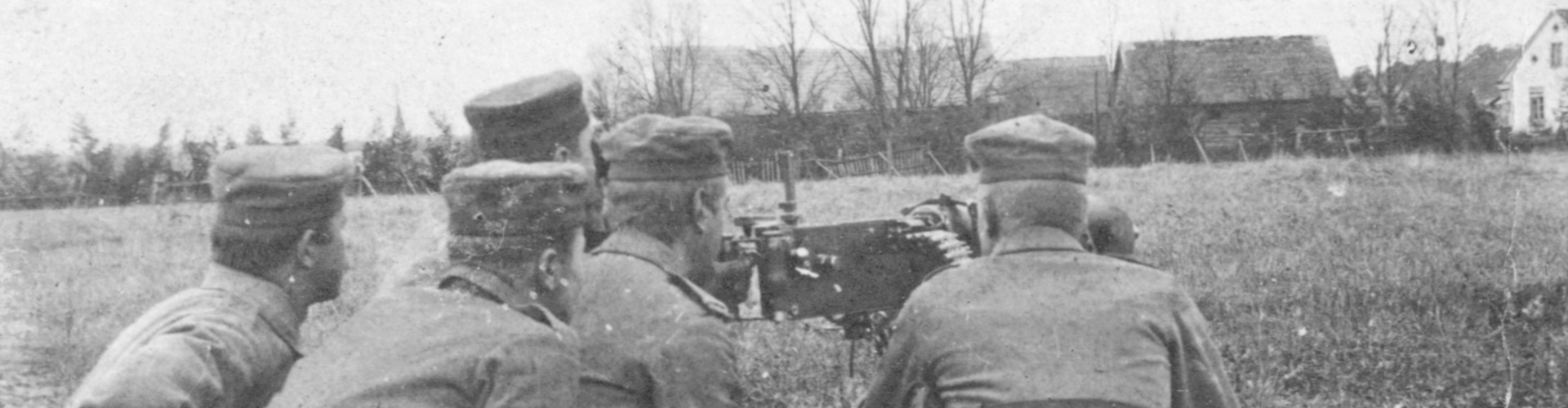
Trench warfare on the Misse River 11.6.1916–24.8.1916
On 11–12 June 1916 the battalion marched to the front line. There it was assigned responsibility for a four-kilometre-long sector along the Misse River in the Tirul marsh area. The marshy conditions made combat operations almost impossible. The distance to the enemy positions was between half a kilometre and one kilometre. The main duties of the Jaegers were fortification work and guard duties.
In July, two units of the battalion became involved in combat on other sectors. The artillery platoon participated in repelling Russian attacks at Ekkau-Kekau from 18–22 July. The Engineer Company, in turn, took part in the attack carried out on the Schmarden sector on 24–25 July, during which a forward Russian strongpoint was destroyed.
Trench warfare in the Gulf of Riga 26.8.1916–13.12.1916
On 23 August 1916, Jaeger Battalion 27 received orders to leave its positions on the Misse River, and the following night it was transported by train to the coast of the Gulf of Riga. Also in the Gulf of Riga, the main duties consisted of fortification work and guard service. Combat activity was considerably more intense there than on the Misse River, and the nearest Russian positions were only 200 metres from the Jaegers’ positions. The battalion was loaded onto trains on 13 December and transferred to Libau (Latvian Liepāja), where it spent Christmas.
Winter warfare on the Aa River 5.1.1917–8.2.1917
Jaeger Battalion 27 was stationed in barracks in Libau until 5 January 1917. At that time, the battalion was ordered to move to the Aa River. On 4–5 January 1917, Russian forces had broken through the frozen Tirul marsh area into the German positions on the right bank of the Aa River.
Of the units of Jaeger Battalion 27, only the artillery took part in combat operations at full strength. The activities of the other units were mainly limited to marches and reserve duties. However, the severe frost and poor accommodation conditions made even these tasks demanding. The number of cases of frostbite was exceptionally high.
The fighting on the Aa River ceased on 3 February 1917, and on 8 February Jaeger Battalion 27 was transferred to the city of Tukums as a reserve unit.
Transfer to Libau 25.3.1917
Jaeger Battalion was transferred from Tukums to Libau on 25 March 1917, where the battalion received further training and participated in the defence of the Courland coast.
The extensive training grounds, shooting ranges, fortifications and naval harbour of Libau enabled versatile training. The training programme consisted of nine courses:
- General Staff course for platoon leaders
- Long-range patrol course for 40 selected Jaegers
- Engineer course for approximately 100 Jaegers. The course included instruction and practical exercises in field fortifications,
bridge and raft construction, as well as demolition work. - Signals course for Jaegers selected from different companies.
- Machine gun course, with 15 Jaegers from each company as students
- Riding course for 30 squad leaders and Jaegers
- Non-commissioned officer course, attended by all Jaegers who were not participating in another course.
- Quartermaster course, with 2 Jaegers from each unit.
- Artillery course, attended only by Jaegers serving in the artillery battery.