
Background of the Movement
Finland’s national military forces had been disbanded during the first period of Russification, known as the first period of oppression, with the last unit, the Finnish Guard, being dissolved in 1905. In the same year, a revolutionary movement broke out in Russia, leading to restrictions being placed on the power of the Emperor. In Finland, these events were accompanied by a general strike and the subsequent November Manifesto, through which Emperor Nicholas II revoked the provisions of the February Manifesto issued in 1899 and promised Finland a representative assembly based on universal and equal suffrage. The first parliamentary elections were held in 1907. However, the Finnish military was not re-established, and Finnish men had no opportunity to receive military training in Finland.
In 1908, however, a new period of Russification began, known as the second period of oppression. Finns responded mainly through passive resistance. The conciliatory movement believed that by complying with Russian demands, at least Finnish national identity could be preserved. There were also supporters of active, armed resistance.
When the First World War began in 1914, Finnish attitudes towards Russia became increasingly hostile. According to the Activist Movement, Finland should seek independence from Russia. This idea was particularly influential among university students.
Jaegers in Germany
Providing military training within Finland was impossible. When Sweden refused to arrange training, Germany was approached instead. For Germany, which was at war with Russia, unrest and a possible uprising in Finland suited its strategic interests. On 26 January 1915, an agreement was reached concerning the training of 200 Finnish university students in Germany. The first Finns arrived at Lockstedt in northern Germany on 25 February 1915 for a training course disguised as a scouting course.
By an imperial order issued on 28 August 1915, the trainees were formed into a military unit. It became part of the German armed forces under the name Lockstedt Training Unit (Ausbildungstruppe Lockstedt). The number of trainees was decided to be expanded to 2,000 men. This required the beginning of extensive recruitment activities. Those recruited had to leave Finland through a secret network of routes. Germany paid for the Jaegers’ travel from the Swedish border to Lockstedt, but the actual recruitment activities were mainly financed through donations from private Finns. The volunteers were not only university students; nearly 500 came from working-class families and approximately one third from farming families, including sons of tenant farmers and crofters.
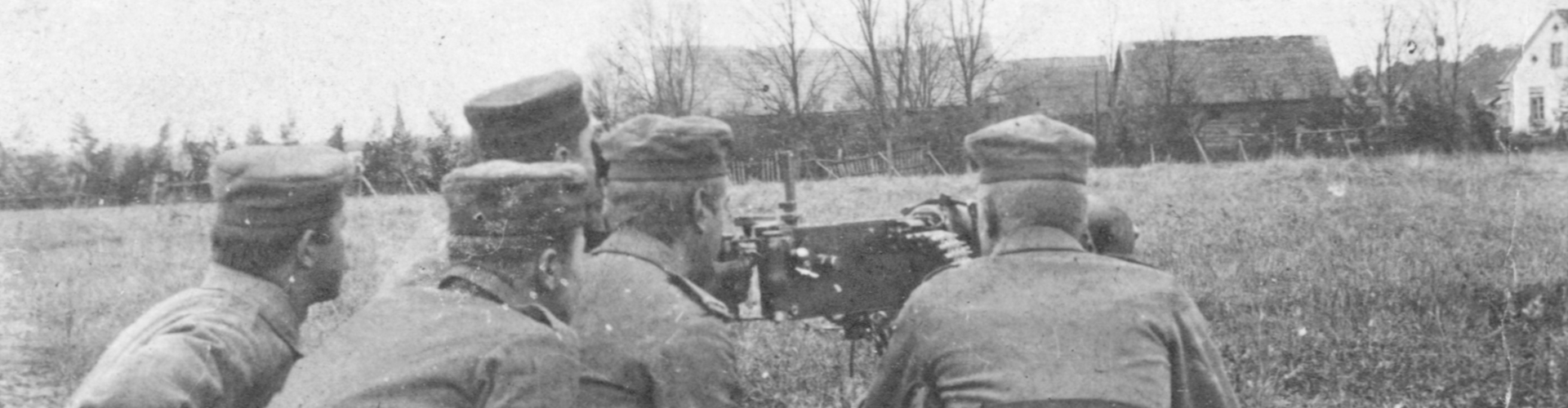
After the training period, the Finnish unit, which had grown into a battalion, was given the name Royal Prussian Jaeger Battalion 27 in May 1916. The Jaegers received green military uniforms and were sent to gain combat experience at the front. At this time, the battalion consisted of 203 Germans and 1,254 Finns and included a headquarters, four Jaeger companies, a machine gun company, a pioneer company, and an artillery section.
In March 1917, the battalion moved to Libau as a training unit. In addition to training duties, its tasks included participating in the defence of the Courland coast, but the Jaegers did not take part in further combat operations while serving in Germany.
The Royal Prussian Jaeger Battalion 27 was officially disbanded on 13 February 1918, and before departing for Finland, the Jaegers swore the military oath as soldiers of the Finnish Army. Before returning to Finland, 79 Jaegers had died, most of them due to illnesses and accidents.