
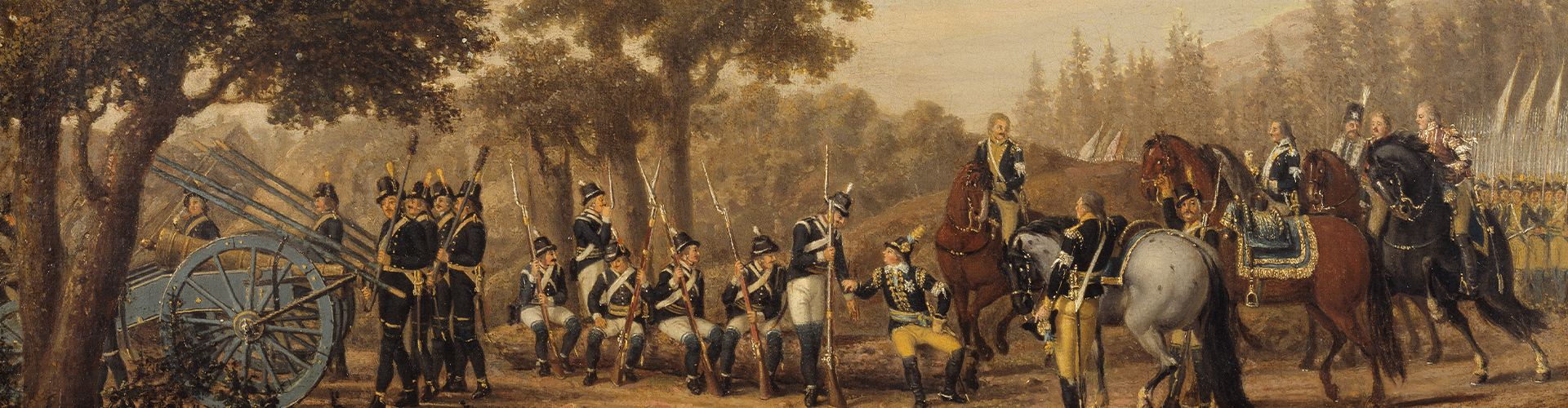
Finland and Its Borders; Between East and West
The area of present-day Finland has long been situated between the spheres of influence of East and West. Merchants, conquerors, and various cultural influences moved across the region from both directions. The tribal and administrative structures of the Finnish territories were loose and relatively unorganized. However, the ancient hill forts indicate some degree of local organization already before the era of the Crusades. Viking expeditions travelled along the Finnish coasts, and the Vikings also ventured inland into the region of Häme.
From the beginning of the 12th century, Finland increasingly became an area of commercial, political, and ecclesiastical competition between Sweden and Novgorod. During the time of Birger Jarl in the mid-13th century, Swedish rule became established up to the Kymi River line, and Finland remained within the sphere of the Western Church and culture. The construction of the castles of Turku, Häme, and Viipuri began in the latter part of the 13th century.
The Treaty of Nöteborg, 1323
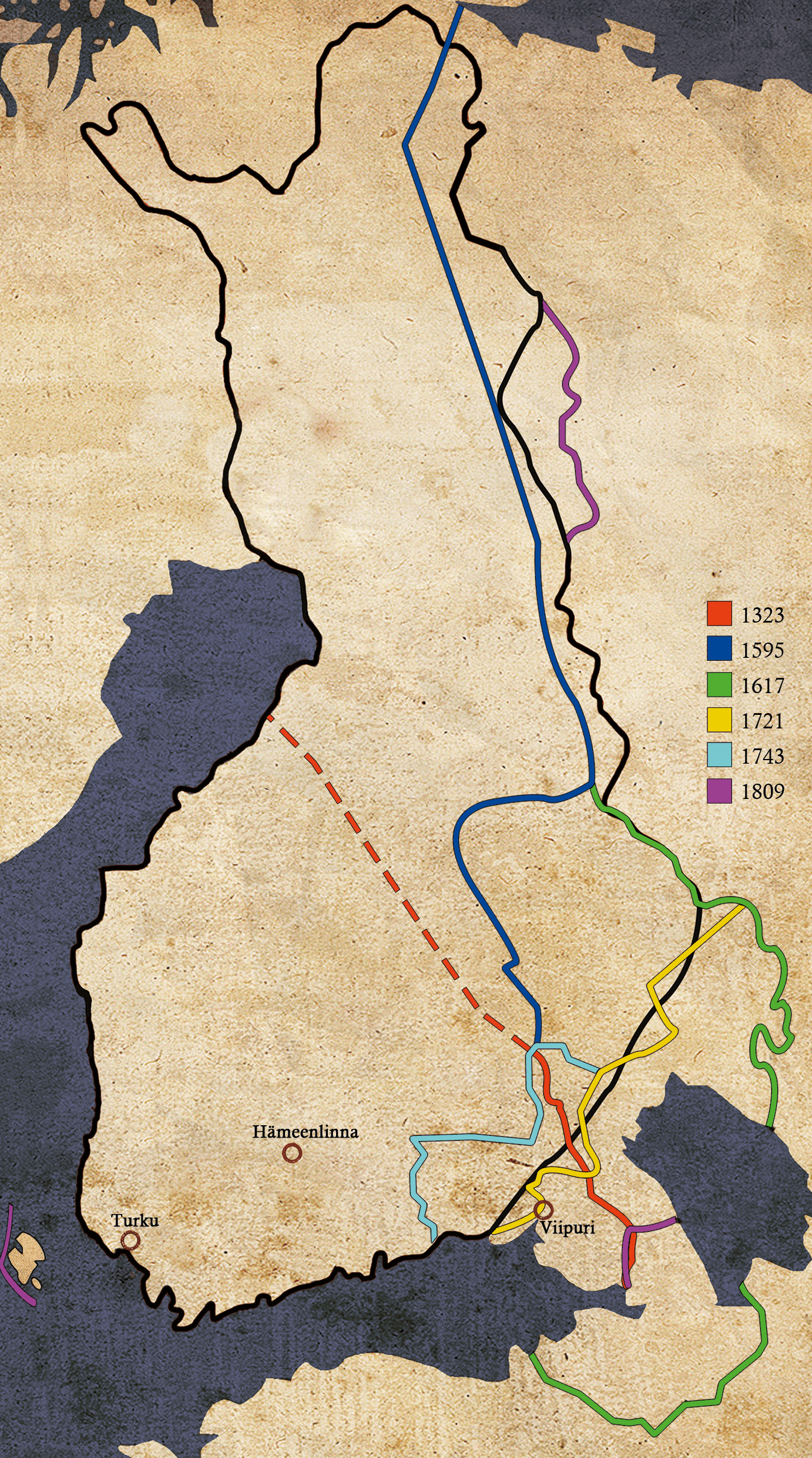
Disputes between Sweden and Novgorod over Karelia continued until the Treaty of Nöteborg was signed in 1323. The treaty defined Finland’s eastern border for the first time. Karelia was divided, although the exact border further north remained unclear. Since there was no permanent settlement in inland Finland at the time, a precise border demarcation was not considered necessary there. The border ended at the Gulf of Bothnia near the mouth of the Pyhäjoki River.
The Treaty of Teusina, 1595
Settlement spread north of the Nöteborg border, and border disputes and skirmishes became common. Gustav Vasa waged war against Russia in the 1550s. The years 1570–1595 were known in Finland as the Long Wrath, during which periods of war and truce alternated between Sweden and Russia. Nevertheless, continuous guerrilla warfare took place in Finnish territory, and many areas became deserted. The war ended with the Treaty of Teusina in 1595, in which Russia relinquished claims to Peräpohjola, Kainuu, and Savo, while Sweden gave up the Kexholm County it had occupied as well as its claims to Viena and Aunus.
The Treaty of Stolbovo, 1617
Long-standing disputes over control of the Baltic Sea region were settled by the Treaty of Stolbovo in 1617. In addition to Ingria, Russia ceded Kexholm and Nöteborg to Sweden. Through the Treaty of Stolbovo, Sweden rose to the status of a major European power, and its position strengthened further during the Thirty Years’ War. During the border survey that followed the treaty, in 1621 a border line hundreds of kilometres long was cut through the forests for the first time, extending from the shores of Lake Ladoga to the area of present-day Kuhmo.
The Treaty of Nystad, 1721
Russia, Denmark, and Poland formed an alliance against Sweden, and the Great Northern War began in Livonia in 1700. Finland was initially outside the main theatre of war, but the Russians eventually occupied Finland in 1713. This marked the beginning of the occupation period known as the Greater Wrath, which lasted until the Treaty of Nystad in 1721. Under the terms imposed by Russia, Sweden’s status as a great power collapsed, and it ceded southeastern Finland to Russia. The new border ran from Virolahti to Porajärvi. The important city of Viipuri was lost.
The Treaty of Åbo, 1743
During the Russo-Swedish War of 1741–1743, the Swedish political faction known as the Hats sought compensation for the losses suffered in the Great Northern War. The war proved disastrous for Sweden, and the Russians once again occupied Finland. This period, known as the Lesser Wrath, lasted until the Treaty of Åbo in 1743. In addition to the territories ceded in the Treaty of Nystad, Sweden lost Hamina, Lappeenranta, and Olavinlinna.
The Treaty of Fredrikshamn, 1809
The Finnish War of 1808–1809 was rooted in Russia’s attempt to pressure Sweden into joining the continental blockade against Great Britain. This pressure ultimately led to war, in which Russia conquered Finland. Under the Treaty of Fredrikshamn in 1809, Finland – including Åland – was incorporated into the Russian Empire as an autonomous Grand Duchy.