
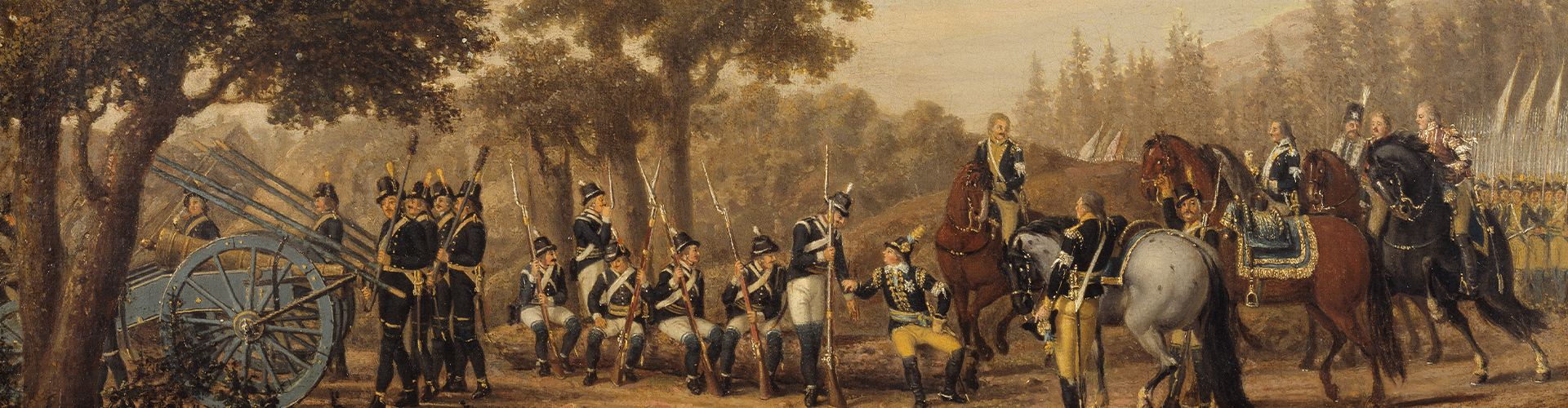
Finnish Artillery Units
During Swedish rule, the armed forces also included Finnish field artillery units as part of the army of the Swedish Realm. The Swedish Field Artillery Regiment was established in 1630, and in 1634 the Master-General of the Ordnance (Rikstygmästare) was appointed as a member of the Swedish War College. The year of this appointment may be regarded as the birth of the Finnish field artillery branch.
Artillery Company in the 17th Century
The Artillery Regiment consisted of eight artillery companies, one of which was the Finnish-Ingrian Company established in 1651. The company was headquartered in Viipuri. By the end of its founding year, the company comprised 103 men serving in small detachments throughout the eastern regions of the Swedish Empire. By the outbreak of the Great Northern War, the artillery company included not only field artillery but also artillery detachments stationed in Finnish castles and fortresses.
In 1689, the artillery branch received its own uniform, consisting of a long grey coat with blue lining and blue cuffs, yellow leather breeches, blue stockings, and a black hat.
The Finnish Artillery Detachment, 1727
In 1727, the Turku Artillery Company was expanded into the Finnish Artillery Detachment, which included the Turku Field Company. The detachment operated approximately 15 field guns, while the entire Finnish Artillery Detachment possessed between 45 and 65 guns in 1733.
The Royal Finnish Field Artillery Battalion, 1736
A reorganization carried out in 1734 strengthened both the Finnish field units and the artillery detachments assigned to castles and fortifications. This led to the establishment of the Royal Finnish Artillery Battalion. Its headquarters were located in Hamina, which had become an important artillery and fortress garrison town. By 1760, the headquarters had been transferred to Helsinki, and ten years later almost the entire battalion had been concentrated there.
The battalion's personnel consisted mainly of enlisted drifters and landless men who, through strict discipline and continuous training, formed a cohesive and highly trained military unit.
The Royal Finnish Artillery Brigade, 1782
In 1782, the field artillery adopted a new organizational structure, and the Royal Finnish Artillery Brigade was established. The brigade was primarily a peacetime organization. During reforms introduced by Carl Gideon Sinclair, commander of the Royal Artillery Regiment, the artillery's wartime organization was revised, and the term “battery” was redefined to mean a formation of six guns. Previously, the term had referred simply to artillery deployed in firing positions, regardless of the number of guns.
The wartime artillery brigade now included batteries equipped with 12-pounder and 6-pounder field guns. Each battery consisted of three two-gun sections. A section typically comprised about 20 men, six of whom were mounted artillerymen responsible for escorting the guns into position and protecting their withdrawal from firing positions.
The Royal Finnish Field Artillery Regiment, 1794
In 1794, the Royal Swedish Artillery Regiment was divided into four independent regiments. In practice, the establishment of the Royal Finnish Artillery Regiment did not bring major changes to the deployment of artillery forces in Finland. However, the regiment became administratively more independent than before, although the supreme command of the artillery remained in Stockholm.
No formal distinction had yet been made between field, fortress, and siege artillery.
The Royal Finnish Artillery Regiment was officially disbanded in 1810 following the Finnish War. This marked the beginning of a break of more than one hundred years before a national Finnish artillery unit would once again be established.

The King's Artillerymen
Colonel Robert Carl Charpantier
b. 1766, Sveaborg – d. 1830, Hämeenlinna
At the age of nine, Robert Carl Charpantier was entered into the rolls of the Royal Finnish Guards Regiment, also known as the Queen Dowager’s Regiment, with the rank of sergeant. By the age of thirteen, he was serving in the Stockholm Artillery as a second lieutenant. In 1783, Charpantier transferred to the Loviisa Company of the Finnish Artillery Brigade. In 1802, he served in Hämeenlinna as a major and company commander.
Charpantier distinguished himself during Gustav III’s War of 1788–1790 and was made a Knight of the Order of the Sword in 1789. He was also a successful artillery officer during the Finnish War of 1808–1809 and received the Grand Cross of the same order for bravery at the Battle of Alavus. Charpantier returned from Sweden to Finland in 1812 with the rank of colonel.

Captain Adolph Lucander
b. 1772, Helsinki Parish – d. 1842, Östersund
Adolph Lucander served in the Finnish Artillery Brigade and later in the Artillery Regiment from 1786 to 1810. During Gustav III’s War of 1788–1790, he served as a captain and staff officer. Lucander’s career also included numerous assignments as an international courier. After the Finnish War, he remained in Sweden and participated as a soldier in the construction of the Göta Canal. From 1828 onward, he also served as postmaster in Östersund. Lucander was made a Knight of the Order of the Sword in 1823 and was promoted to major in 1835.

Major Gustaf Adolf Kurtén
b. 1760, Espoo – d. 1824, Espoo
Gustaf Adolf Kurtén worked in surveying duties in Finland from 1777 onward. In 1790, he joined the Finnish Artillery Brigade as a second lieutenant. While serving in the Artillery Regiment, Kurtén was promoted to captain in 1802. For several years he served with great skill as the regiment’s training officer.
During Gustav III’s War of 1788–1790, Kurtén served as a field auditor. In the Finnish War of 1808–1809, he gained distinction as the capable and courageous commander of a section formed from two Russian howitzers captured at Siikajoki. Kurtén was made a Knight of the Order of the Sword in 1808. He owned the Pakankylä Manor in Espoo.

Major Gustaf Johan Uggla
b. 1760, Janakkala – d. 1836, Gävle
Gustaf Johan Uggla entered the Artillery Battalion as a cadet in 1776. He completed his artillery examinations in 1778 and was promoted to second lieutenant the following year. Uggla resigned from service in 1781 but joined the artillery of the Savolax Brigade in 1788. He distinguished himself during Gustav III’s War, notably at the Battle of Porrassalmi in 1789, although he was also captured during the conflict.
After the war, Uggla returned to the Finnish Artillery Brigade. During the Finnish War of 1808–1809, he served as a battery commander in the Savolax Brigade and was appointed a Knight of the Order of the Sword in 1808. He was promoted to major in 1809. After the war, Uggla remained in Sweden and served in the Wenden Artillery Regiment and the North Scanian Infantry Regiment.

Major Samuel Elfving
b. 1760, Loviisa – d. 1837, Kristianstad
Samuel Elfving was entered into the rolls of the Finnish Artillery Battalion as a candidate in the year of his birth. At the age of thirteen, he was appointed quartermaster sergeant, and by fifteen he had attained the rank of sergeant. Elfving completed his artillery examinations in 1783 and was promoted to second lieutenant in Loviisa in 1791.
Elfving participated in both Gustav III’s War and the Finnish War. In recognition of his service during the latter, he was promoted to major in 1809. He was also made a Knight of the Order of the Sword in the same year. After the Finnish War, he remained in Sweden and served in the Wenden Artillery Regiment, where he was promoted to colonel in 1818.

Major Thomas Wahlberg
b. 1770, Lapinjärvi – d. 1815, Espoo
Thomas Wahlberg entered service in the Artillery Brigade as an artillery cadet in 1788. For his conduct during Gustav III’s War, he received a commendation for bravery. Wahlberg was promoted to second lieutenant in 1789 and completed the advanced artillery examination in 1799.
During the Finnish War, Wahlberg was promoted to captain in 1808. He served as a battery commander, among other engagements, at the Battle of Oravais. For the bravery he displayed there, he was made a Knight of the Order of the Sword. Wahlberg was promoted to major in 1810. After the war, he returned to Finland and served in several civil positions, including that of Crown Bailiff.
